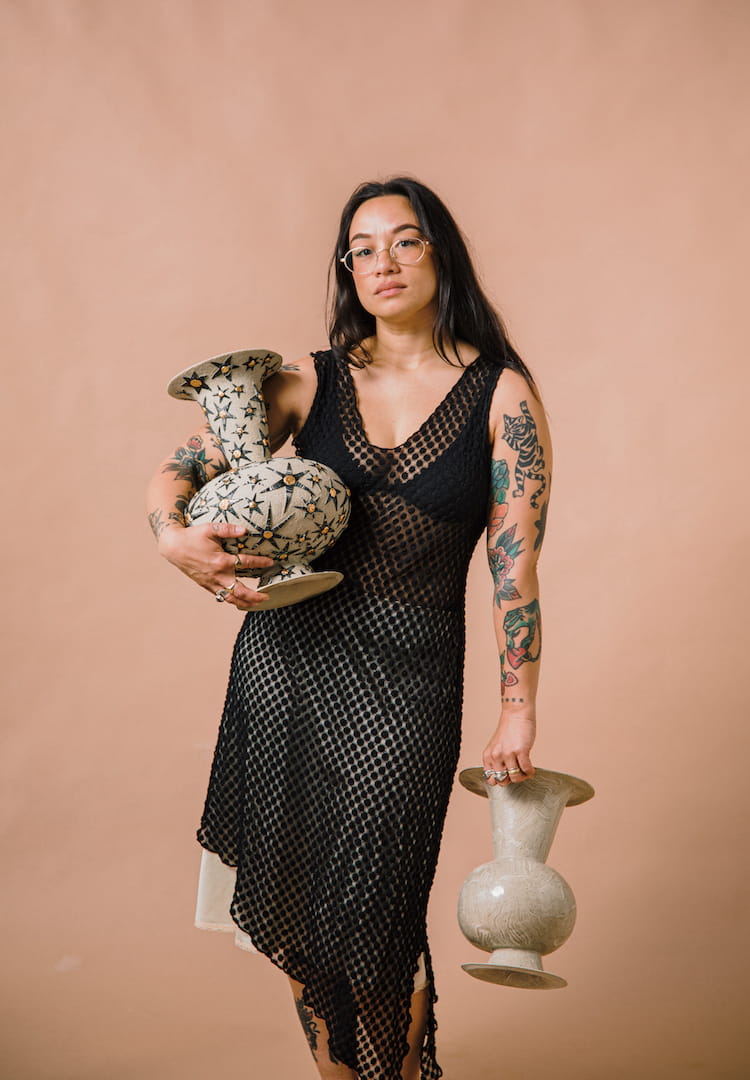



Ceramicist Tantri Mustika is taking no notice of the art world
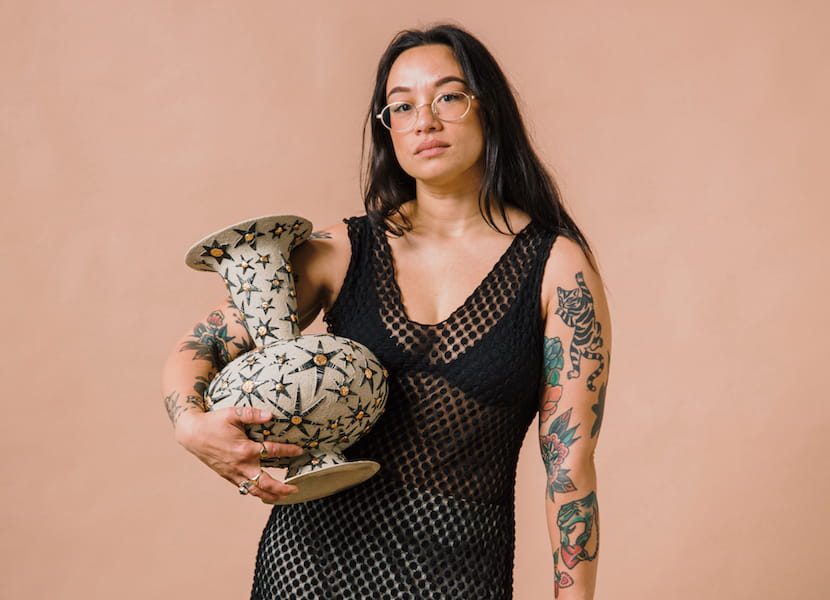
Photographer – Annie Trumble
Stylist – Sinead Hargreaves
Location – RUMA Studio
Words – Phoebe Cannard-Higgins
Tantri wears footwear by GUP throughout
“There are lots of rules in the art world, but no one really knows them.”
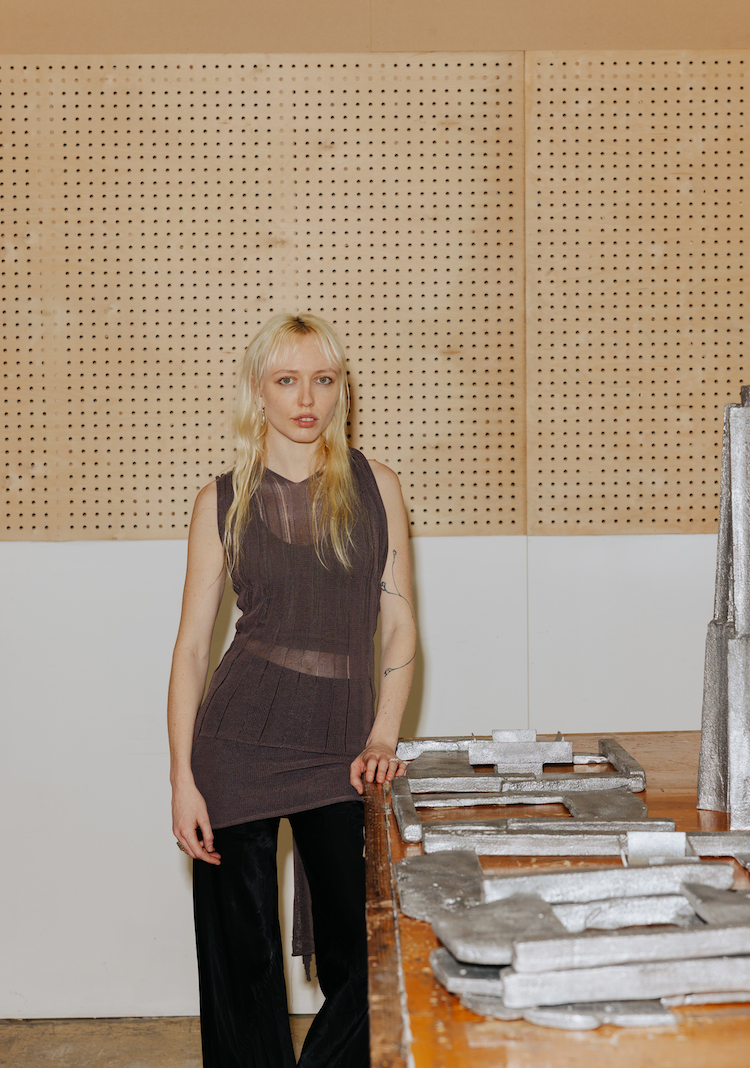
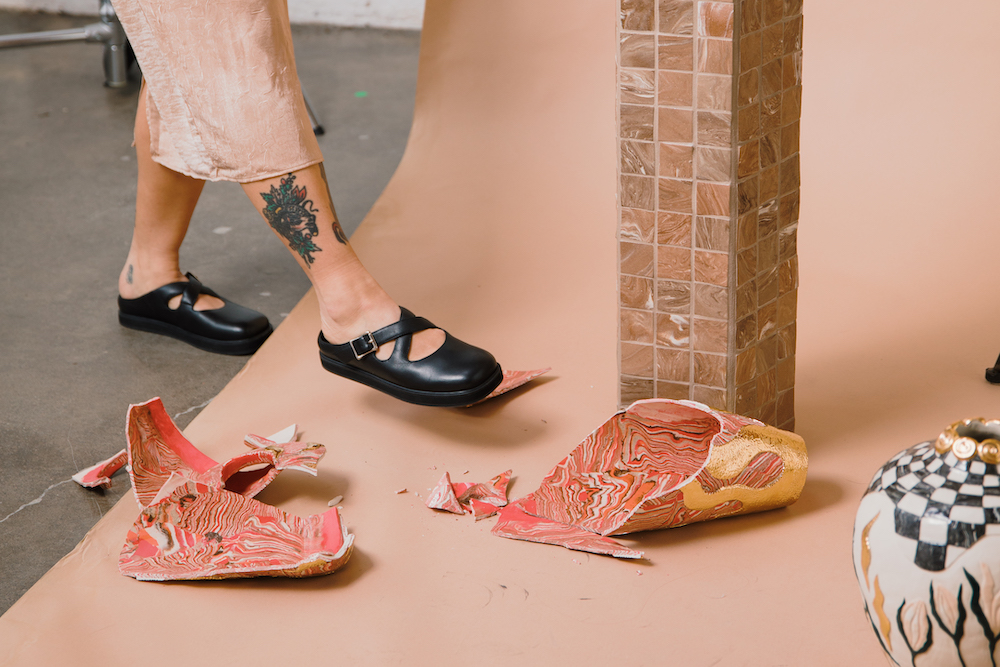
There’s so much heartbreak in pottery,” says ceramicist Tantri Mustika. I’ve just witnessed it for myself. During today’s shoot with Fashion Journal, Tantri accidentally kicked over a vase while readjusting for a photo. The broken shards of red, white and black marbled clay lay on the floor, like an Easter egg cracked open.
Tantri is seemingly unfazed, laughing and scolding herself for being so clumsy while the rest of us stand around with our hands over our mouths.
Interested in hearing how others navigate the world? Head to our Life section.
“There’s also a lot of mystery,” she continues. “Sometimes things happen and you’re just absolutely left scratching your head, like, I don’t understand why this worked last time and it didn’t work this time. Such a small variation can create wildly different results.”
For these reasons, Tantri says it’s helpful to surround herself with other potters, people who understand the unpredictability, struggle and bravery involved in making great art. “I think it’s absolutely necessary to take risks,” she says.
Last year, for 100 Lights, an exhibition at Melbourne Design Week, Tantri set out to create a floor lamp made of 12 separate ceramic pieces delicately stacked atop one another. “I wanted to push myself, make something that was complex and fully immerse myself in the project, go a bit wild,” she reminisces.
She’d been working on the design for months, but it just hadn’t come together. Two weeks out from the exhibition, she finished carving a beautiful centrepiece, one she thought was the perfect shape. “Just as I was about to put it in the kiln, I put my whole fist through it, and the whole thing smashed. Then I was in panic mode.”
But when there’s pressure and no time to think, Tantri makes her best work. “It was like that mistake was meant to happen because the actual lamp that came out was way more perfect. I couldn’t have planned it better.”
The result was her ‘Flow State’ lamp, a breathtaking layered structure resembling an upright string of beads, threaded onto a slender column and topped with a lustrous shade dripping with baroque pearls. Tantri’s carved signature floral motifs decorated the centrepiece, reflecting her Balinese heritage. “This was a no-detail-spared kind of lamp,” she says.
“I was really self-conscious about submitting it to the exhibition, actually,” she tells me. “I don’t know where my work sits in the Melbourne art and design scene.” But she decided, “As long as I love the work, that’s the most important thing.” As it happens, the lamp was extremely well received.
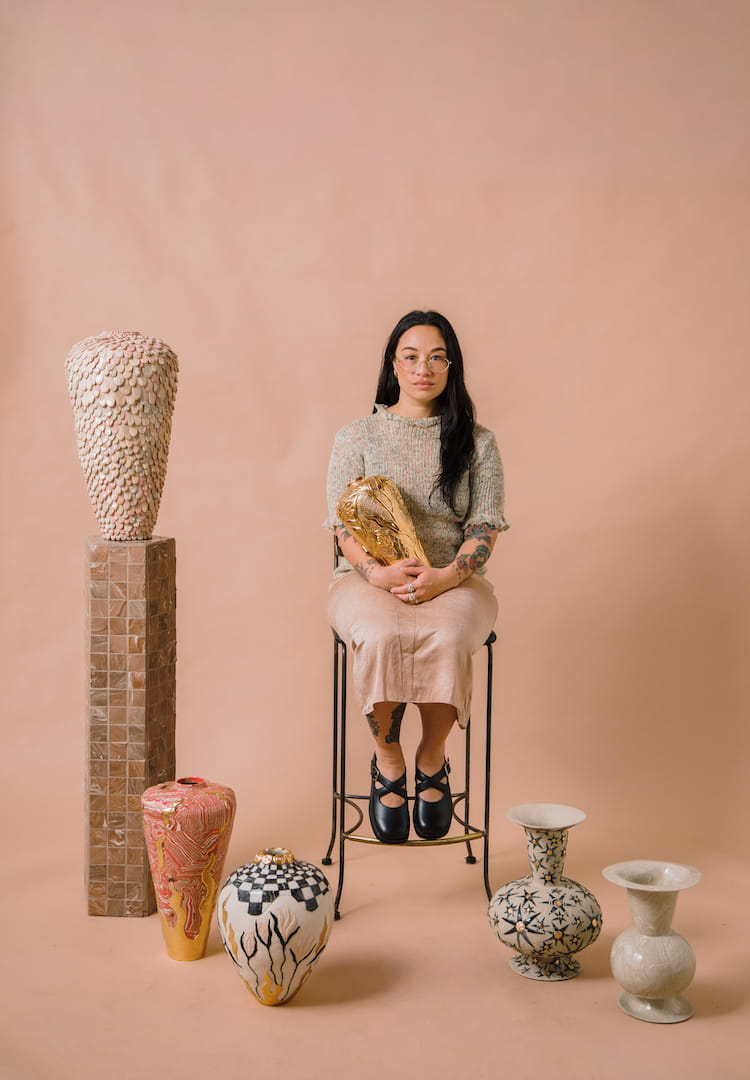
Tantri says her designs, though influenced by the cultures of her Balinese father and German-Russian mother (a “creative force” in her life), often come from her dreams. A clairvoyant once told her that the spirit of her artistic great-grandmother lingered with her and that Tantri would become an artist. She now feels destined to be working in this field, but growing up, she never thought of herself as creative – she just liked to make things with her hands.
“I call myself a milk-crate kid because I’d always be at the back of whatever cafe my dad worked at, sitting on a milk crate,” she recalls. “My dad would feel bad, so he’d give me five dollars and say, ‘Go do something with it.’”
With the cash, Tantri bought acrylic paints and canvases from the newsagent, or beads from the bead shop, and worked away.
At 15, she started part-time hairdressing, a trade that fed her imagination through the avant-garde cuts and colours of the early 2000s. But after a while, she became bored. Her housemate encouraged her to get a hobby and invited her to use whatever she had hanging about in their craft room. “I picked up the clay and never put it down again,” she says.
The hobby quickly became an obsession. Tantri began taking a box of clay to work so she could make ceramics from the back of the salon during breaks, or if a client didn’t show up for an appointment. “I now see that I was soothing myself,” she says. “When I picked up that clay, everything else just melted away.”
She has now been running her ceramics business for a decade. It’s gone through a myriad of stages, from sales via social media to the opening and closing of a shopfront in Collingwood Yards. She’s experienced cycles of burnout but always comes back with new insight to make her business stronger. Whenever she tries turning her hands to something else, a “gravitational pull” returns her to clay.
In the beginning, her work had a product focus. Her popular terrazzo mountain vase, dome-shaped and inlaid with colourful, marbled fragments, was small and relatively simple to make, and sold well. These days, Tantri’s work is predominantly fine art and conceptual, imbued with meaning, memory and her current mindset.
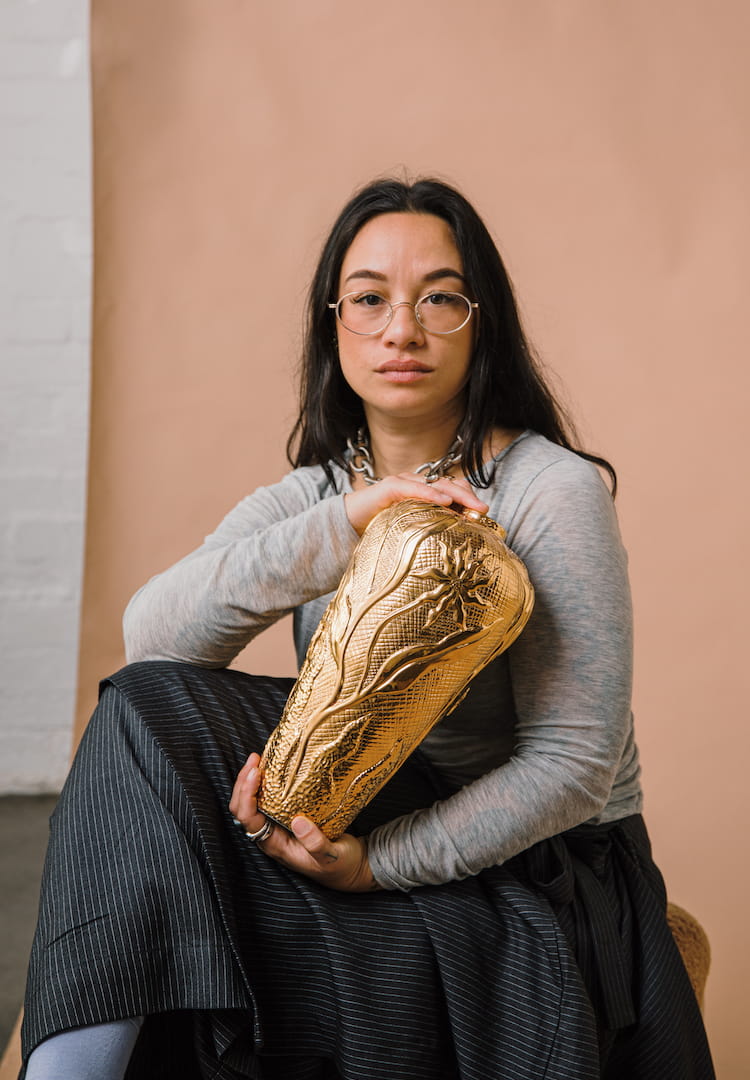
Now, she creates from a studio in Carnegie, where she can draw the curtains, sing, dance and make pottery, unobserved in her meditative flow state. Repeated motifs appear in her work, such as flames, a Balinese symbol of cleansing and rebirth. The star-flower hybrid is a visual representation of her mum’s favourite line: “Don’t worry, babe, everything is already written in the stars.”
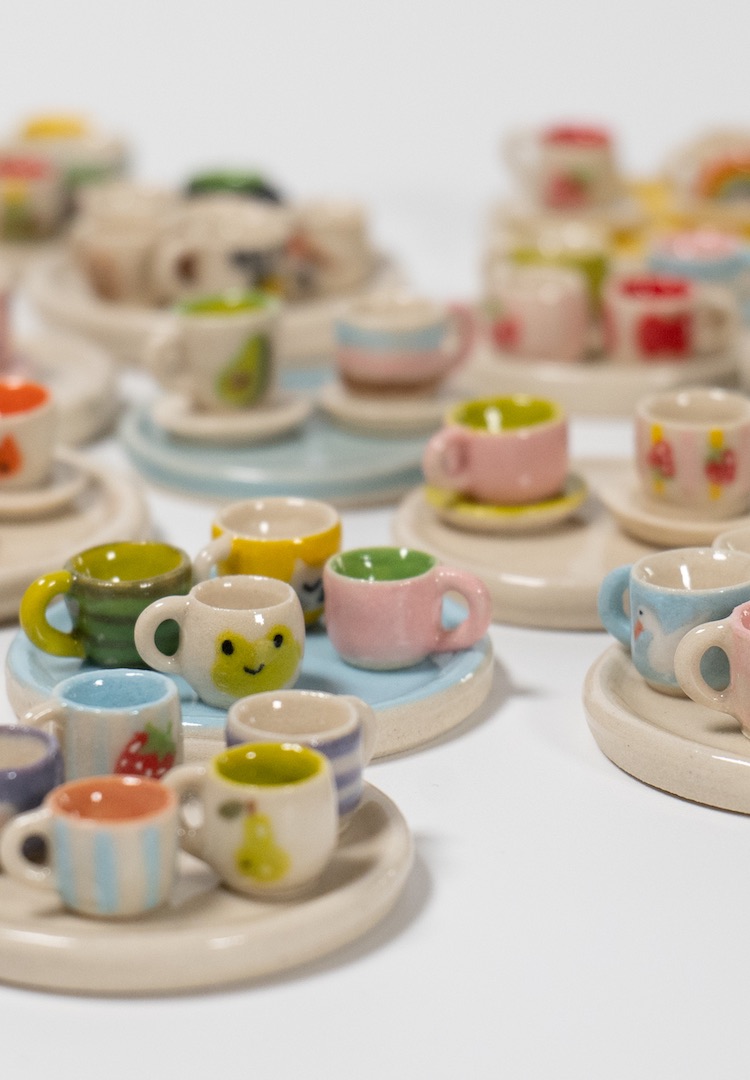
Tantri mainly sells to interior designers, architects or private clients, but she still likes to have some smaller, less labour-intensive pieces available at an accessible price point. People in the art world have advised her against this approach, but she’s not taking notice.
“I don’t come from wealth,” she says. “So it’s important to me to have pieces that anyone could buy. There are lots of rules in the art world, but no one really knows them.”
When it comes to business, she has a mantra: “Life is long, nothing must be solved today, and iteration, iteration, iteration.” In saying that, she’s currently getting some business management help from a friend, who’s trying to reel her in a bit. “She’s telling me to stop putting gold on everything because it’s expensive,” she laughs.
“She’s calling me a punk, and I’m like, ‘Yeah, I am’. This is my little act of resistance. Like, I wanna make stuff that’s so detailed, it’s so impractical, but it’s what the work needs and it’s what my soul needs.”
This article was originally published in Fashion Journal issue 201.
For more from Tantri, head here.
Liked this? You’ll love these...