

The art of ambiguity: Inside Emma Creasey’s surreal world
PHOTOGRAPHY BY ANNIE TRUMBLE
STYLING BY SINÉAD HARGREAVES
WORDS BY PHOEBE CANNARD-HIGGINS
Notes on practice.
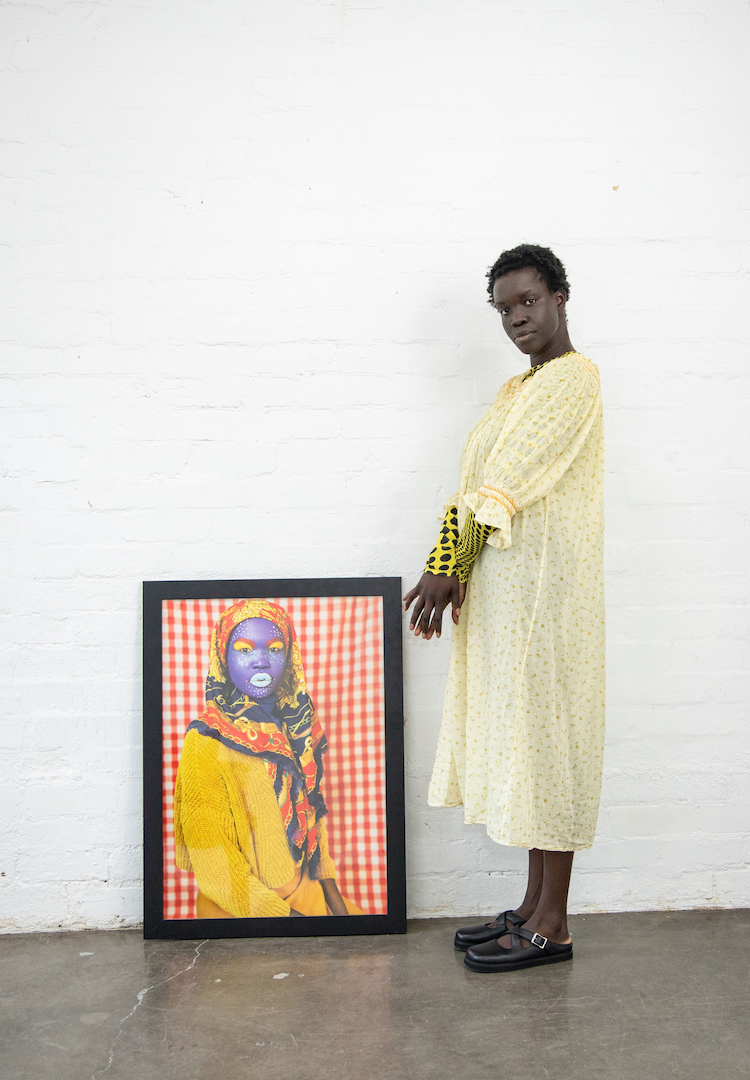
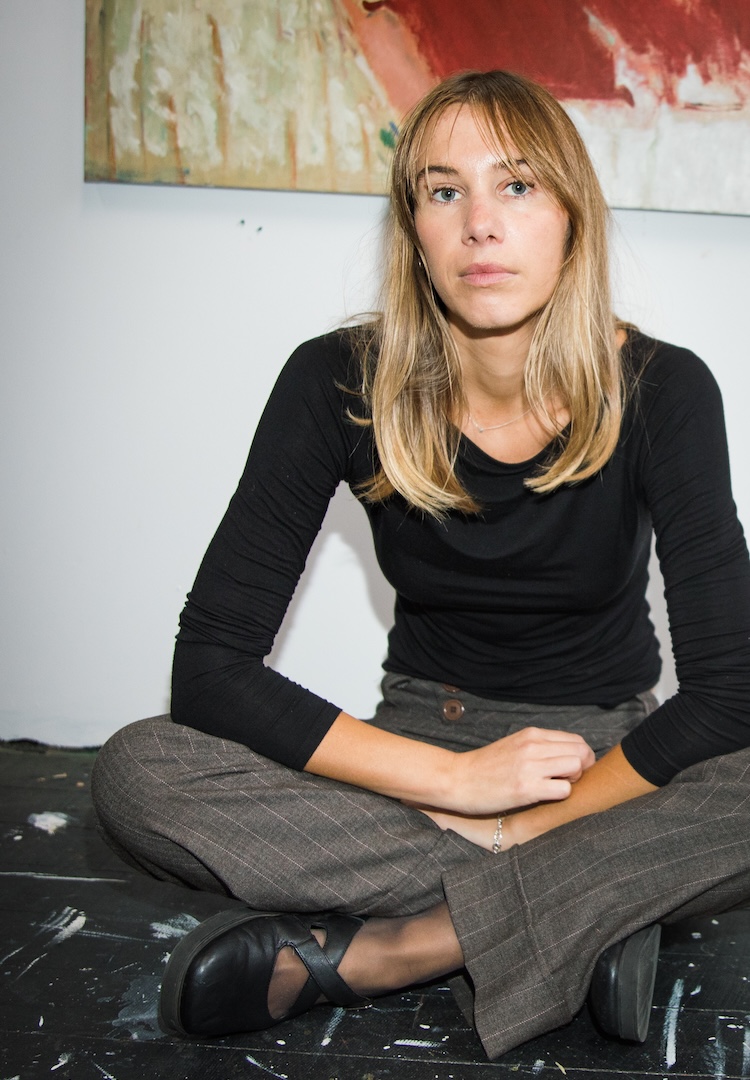
We meet Emma Creasey at Easey Street studios in Collingwood after a spontaneous Melbourne downpour. She leads us inside, past many small rooms ensconced in an old warehouse, each door marked with a neatly hand-drawn number and the occupant artist’s name. Em, a visual artist, has been here for three years but tells us she’s planning to leave soon, for a house swap in Sydney.
As the photographer sets up, Em and I are left alone in front of her paintings. We quickly discover we’ve both read and loved The Surreal Life of Leonora Carrington by Joanna Moorhead. Em tells me how Surrealism, particularly Carrington’s work, has shaped her recent practice. It feels right to her now.
For more content like this, have a look through our Life section.
In Carrington’s biography, Em encountered a line she can’t quite recall. “It was something like, what is the difference between being a serpent and being human?”
“Every now and then there’ll be a line that sparks an image, little fragments that stay with you,” she says.
The serpent line generated a series of small works arranged along the floor. As I crouch down for a closer look, I see four figures standing with their backs to the viewer, looking out over lush green foliage and a large winding serpent. I ask if there’s something religious about these paintings.
She tilts her head. “I paint a lot of people with their hands in front of their bodies. Sometimes I think they’re praying, but sometimes I think they’re clapping.”
It’s refreshing, the acceptance of ambiguity. There’s no neat pitch. The work feels alive, shifting with perception, interpretation, mood. This may be my favourite thing about surrealism: its refusal to emit singular truths.

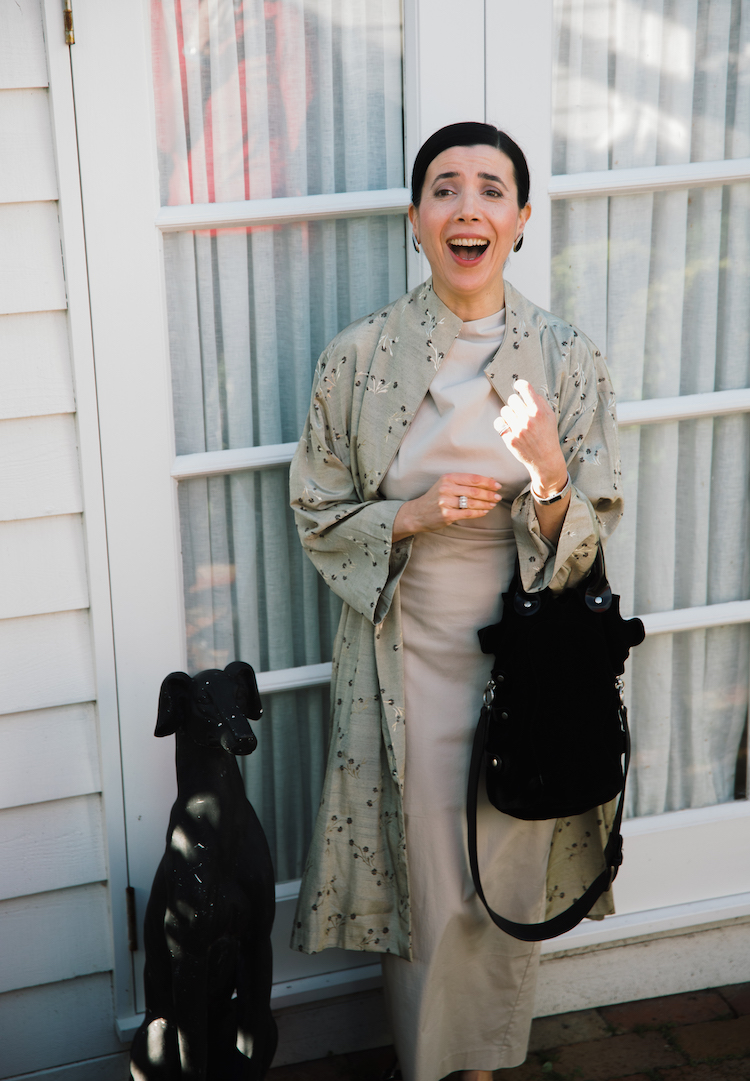
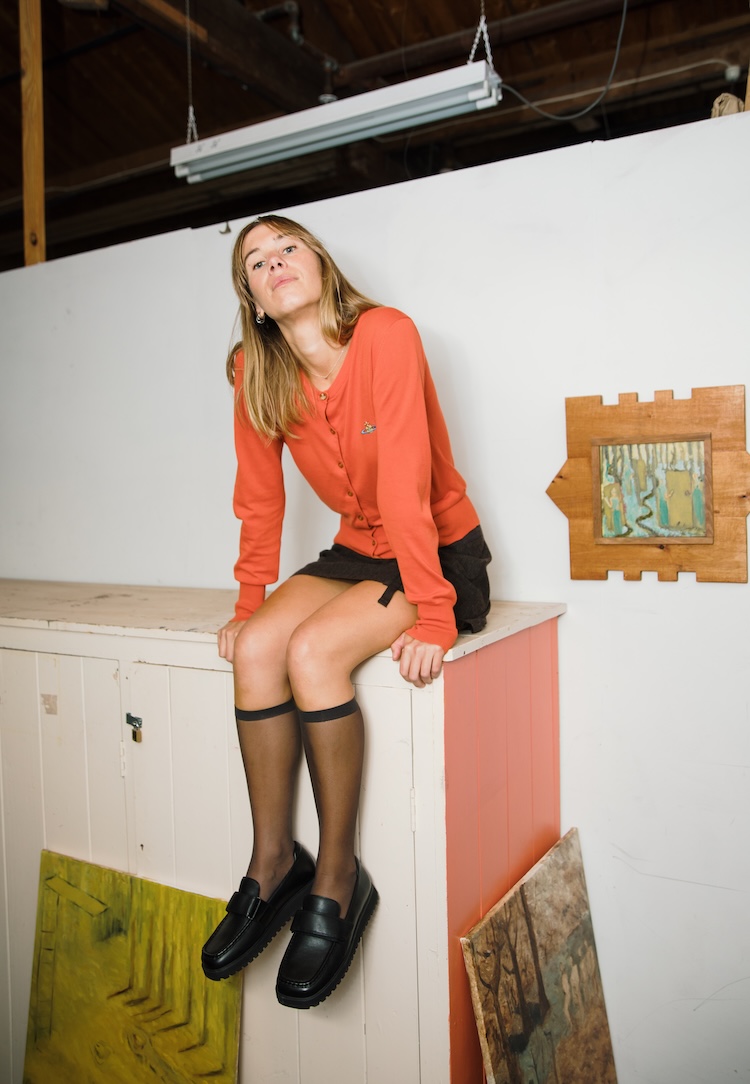
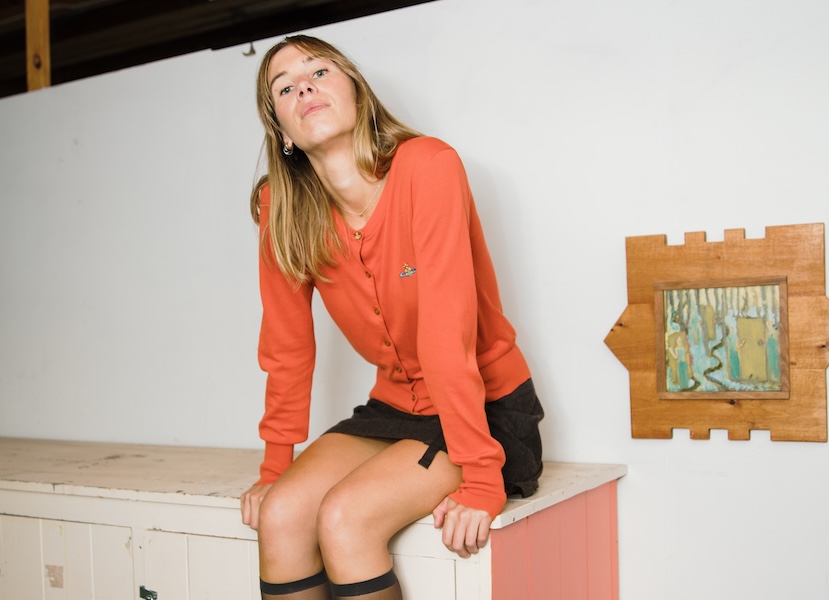
Em wears her own clothes and shoes by Gup throughout.
“Who are these characters?” I ask, pointing to a row of figures in the foreground of another painting, holding white boats like offerings to the sky.
“I used to think of the people in my work as versions of myself,” she says. ‘But recently I’ve started seeing them as entirely separate characters.”
Em didn’t grow up around art in a formal sense. “We weren’t the kind of family that went to galleries,” she says. “I didn’t grow up thinking I’d be an artist. It took a long time.”
She began painting more seriously during Covid and since then has maintained a regular practice while holding down a patchwork of jobs: event management, festivals, a spell at a wine bar. Her practice is largely self-taught through YouTube tutorials, art books and podcasts, her favourites including The Great Women Artists, Talk Art, and Sound & Vision.
A turning point in Em’s art career came when Ben Mooney of Ma House reached out on Instagram to commission a large-scale work. Nearly two by three metres, far bigger than anything she’d previously attempted. The commission pushed Em out of her comfort zone and led her to secure her first studio in Brunswick. “We were so chaotic, we measured his wall in couch cushions.”
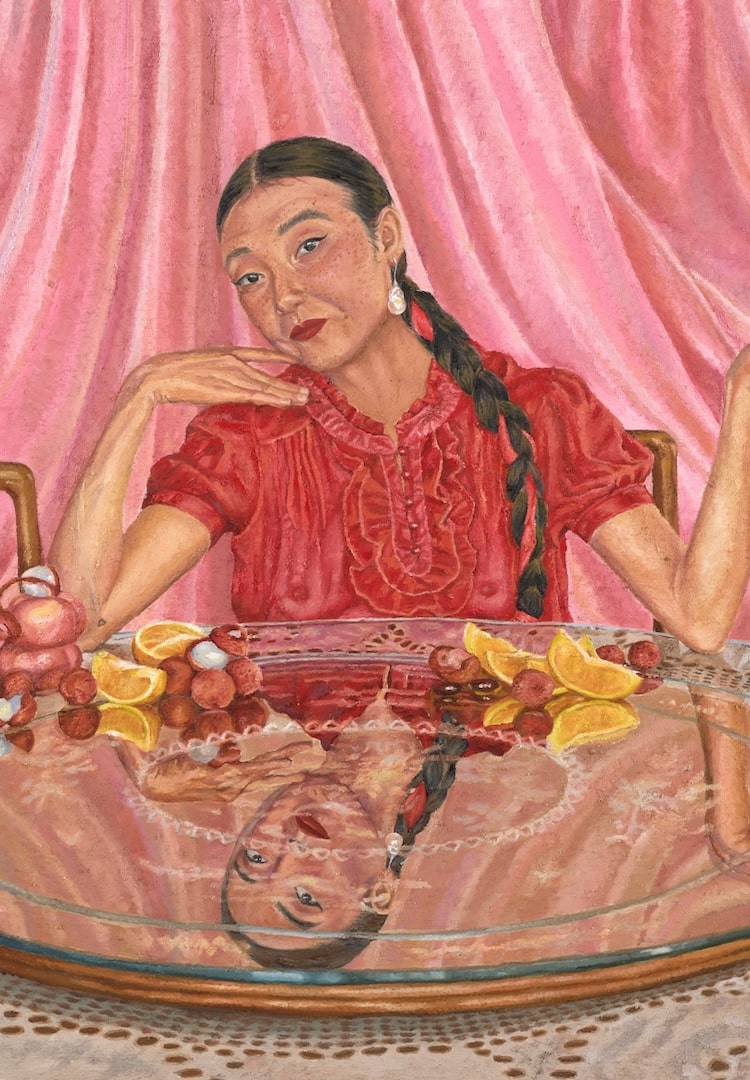
The finished painting, of a dining table laid with glass bowls holding oranges, persimmons and lemons, has become an indelible feature of Mooney’s antique homewares store on Johnston Street. Soon after, Em’s work caught the attention of art dealer Lily Mora, who began selling her art through Sunday Salon, an online gallery representing emerging Australian artists.
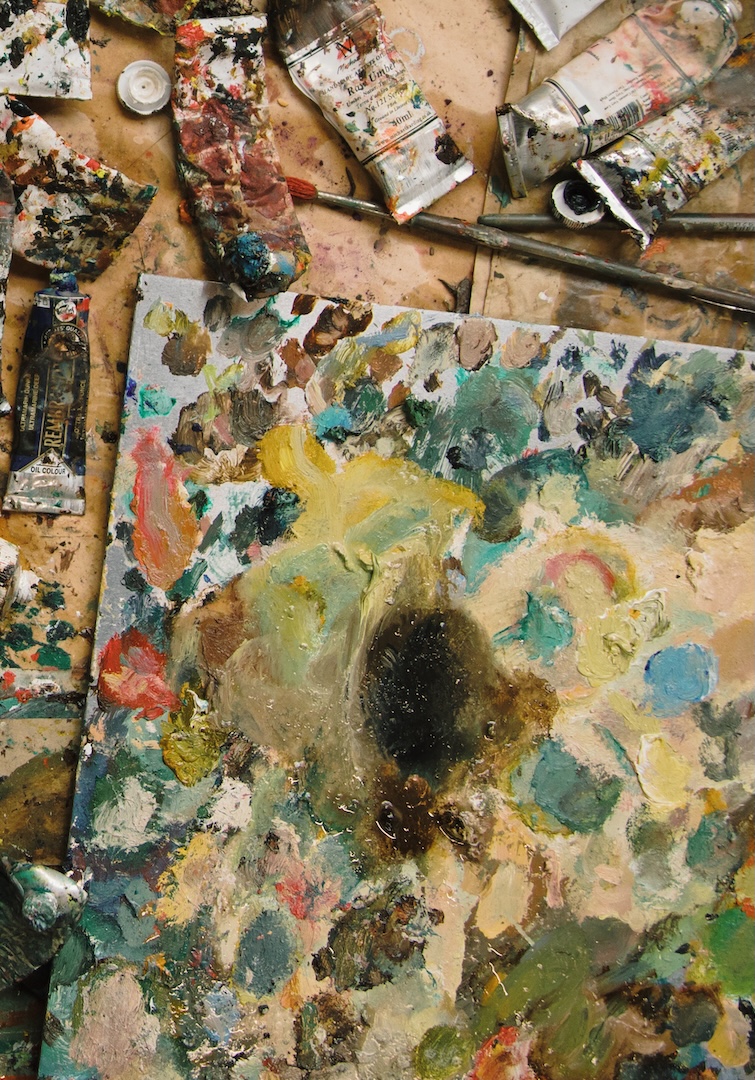
Em’s early paintings focused heavily on food: jellies and cakes painted in rich pinks and reds, espousing a kind of feminine decadence. Over time, her work has shifted, taking a turn down a more surreal path. Figures emerged, then curtains. “I went through a big curtain phase,” she laughs.
Her recent move to animals, predominantly horses, has been about stepping away from interior spaces. “The early work was very inside: the bed, the table, the house. To be external, painting animals and nature, feels like a kind of freedom.”
Em paints from her imagination. In one work, a horse grows a tree from its back. In another, three figures stand in a forest holding what appear to be doors, perhaps shields.
She draws on a wide range of influences, from historical figures such as Carrington to contemporary artists like Colleen Barry. She admires Barry’s vivid, offbeat portraits, which often slip into the bizarre, such as bright foxes breastfeeding human babies. She also values Barry’s generosity online, where she shares tips and tutorials on Substack and Patreon.
In 2022, Em took part in the All That We Are artist residency in Tasmania, run by the parents of Australian artist Georgia Spain; one of her favourites. She painted in Spain’s old studio, surrounded by her early works and oil studies.
I ask Em whether she thinks of herself as having a painter’s persona that leaves the studio with her. She shakes her head. “There’s a studio version of me which is so different and so messy,” she says, “that doesn’t really leave the studio ever.”

She tells me how, especially when she had a desk job, she would treat changing from office wear into scrappy jeans and paint-flecked T-shirts as a kind of reset, “like stepping into a different energy”.
Just as Em’s life requires her to inhabit multiple selves – the artist, the event coordinator, the waitress, the friend, the girlfriend – her paintings are populated by multiples: clusters of figures, usually three or more, performing similar actions or gestures.
And then there are the bunnies. Behind us, propped against the wall is a green painting of small round bunny emerging from the darkness. While bunnies often denote cuteness, these ones feel distinctly sinister. “Yeah, they’re eerie. I felt like I didn’t know if they wanted me around.”
It started when she was house-sitting for a colleague. Em found herself surrounded by Sylvac bunny figurines and after weeks in their company, they began to occupy her imagination. Initially, she intended to paint a single, small painting as a thank-you gift, but they quickly became a compulsion. She returned to the motif again and again, less concerned with how the bunnies looked than with the act of painting them.
For a group show earlier this year at Sullivan and Strumpf, Em had prepared an entirely different body of work, but to her surprise, the gallery chose the bunnies instead. I can see why, they’re simultaneously charming and creepy.
What lingers after speaking with Em is a curious desire to find that line about the serpent and the human being. I flick through the book on my desk and Google it a few different ways but still can’t find it. I could re-read the entire biography, but somehow it feels more fitting not to pin it down completely. If I’ve learnt anything from Em’s paintings, it’s that some things seem to gather more meaning in their ambiguity.
Emma Creasey has an upcoming group show at Hake House in Sydney, opening in early September. Find more here.
Liked this? You’ll love these...