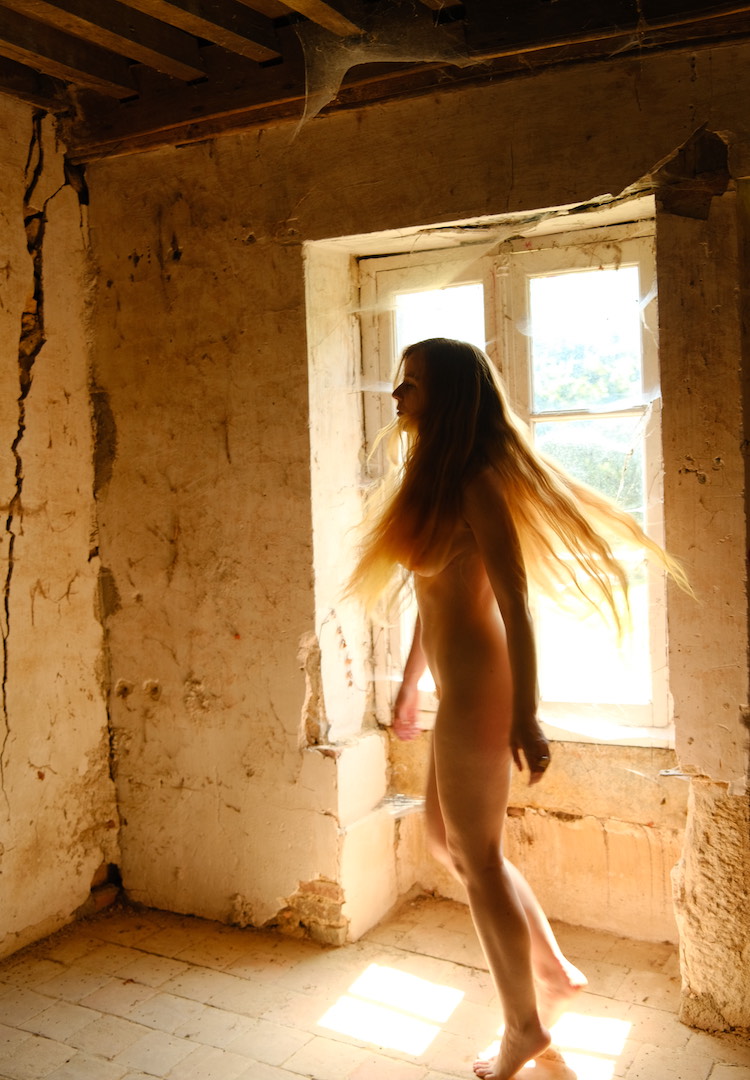


Lessons in letter writing, from Joan Didion to Leonard Cohen
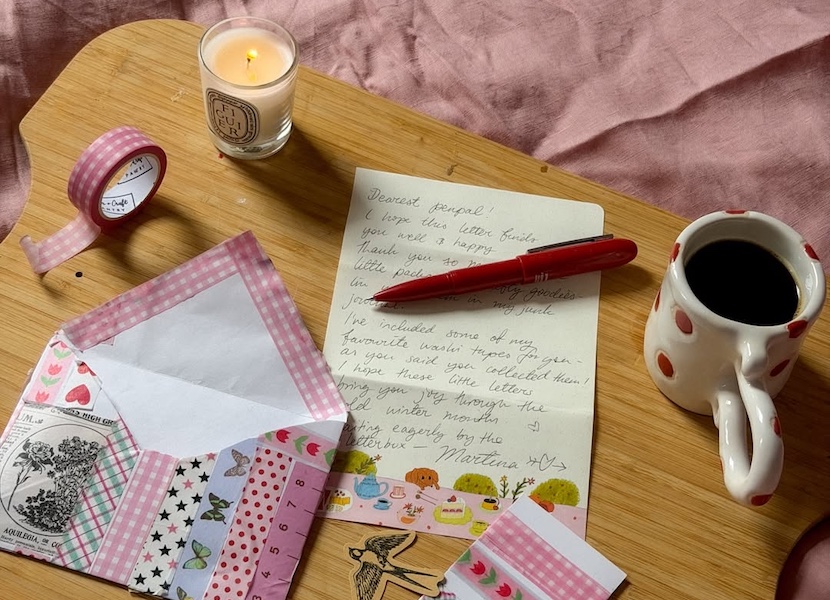
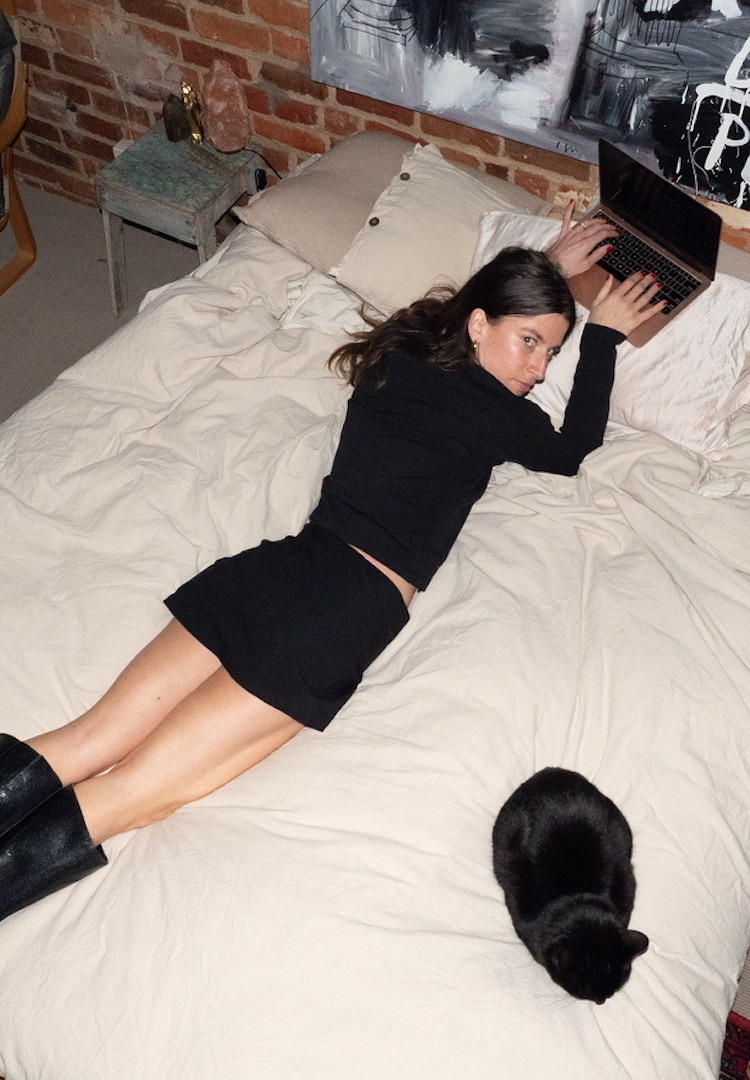
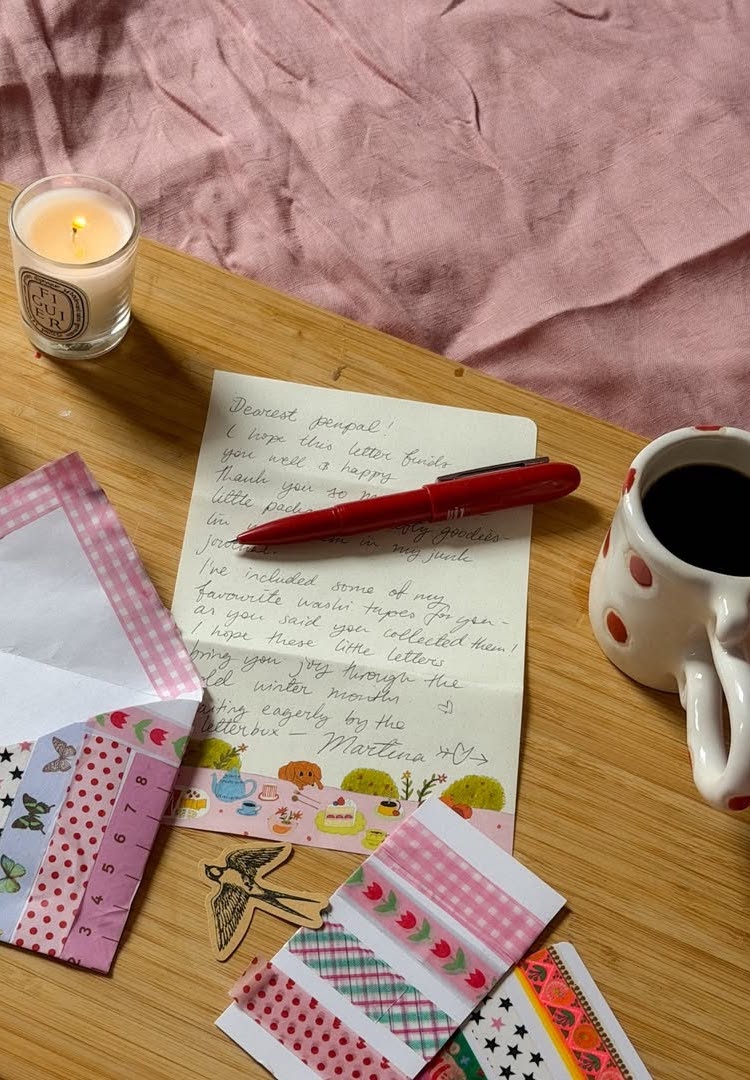
image via @martinamartian/INSTAGRAM
words by constance mcdonald
Dear my favourite hedonist.
Do you remember how it feels to receive a letter? To come home and check the mailbox, expecting only unwelcome correspondence from the taxman or an updated student loan balance, and instead finding a plump envelope with your name written on it?
Your name, not printed but handwritten. You study the loops and familiar tilt of the letters, and turn the envelope over to check the back and confirm your guess of the sender.
For more content like this, tap through to our Life section.
The great musician and poet Leonard Cohen once wrote, ‘I want your absolute attention’. A letter is proof that someone has devoted their time, their absolute attention, entirely to you: pen to paper, to postbox, to your hands.
To write a letter is deliberate. It costs time, attention and postage. Maybe letter writing is a practice worth preserving precisely because of its inefficiency.
You notice the smell of the paper, maybe sprayed with perfume or just the faint scent of another home. You watch how their handwriting moves at the pace of their thoughts, speeding up with excitement and slowing down with concentration when remembering how many ‘c’s and ‘m’s are in ‘accommodation’.
German philosopher Walter Benjamin wrote about aura, that mysterious quality that clings to things touched by human hands. Letters have aura in the way they are bruised with the marks of their making. The creases and folds, the crossed-out words, and the ink smudging from raindrops collected from house to postbox on a less-than-perfect Melbourne day.
Letters are fragile things. They’re vulnerable to fire, water and time, but still they endure in underwear drawers, under beds and in attics. Mary Shelley’s husband, the poet Percy Bysshe Shelley, died at sea at age 29, just a few years after she published Frankenstein. When his body was cremated on the beach, his heart did not burn. It was given to Mary, who kept his heart wrapped in a letter and poem he’d written until she died.
A friend once described to me the quirks of her boarding school days. Every Sunday meant ‘letter writing hour’, during which every girl had to write to her parents. As far as mandatory institutional practices go, this is very darling. My friend’s parents kept all her letters.
Before my siblings and I were born, my dad worked in the mines in Australia to make money to buy the engagement ring for my mum. He wrote to her every day. She replied once a week. The letters are in an old suitcase, versions of my parents that I’ve never met.
It might’ve been a while since you sent or received a letter. Let’s cast a correspondence spell. Let’s write a letter together.
A guide to letter writing
Dear Reader,
Go to the kitchen and open the top drawer. Find the scissors and cut a lock of hair from the back of your head. Find some paper, any paper, maybe even that Chelsea Hotel pad you’ve been saving. What perfume are you wearing these days? Fetch the bottle and a ribbon from your junk drawer.
Find your Pillow Talk lipstick, or whatever you have. And get that thin, inky pen from your handbag that somehow makes your handwriting tidier than normal.
Maybe at your parents’ house, you have a box of treasures, or perhaps it’s just steps away in your wardrobe or under your bed. Inside: black and white photobooth strips from Flinders Street Station that you remember holding while they dried. A handmade birthday card from your high school best friend. Some proof you are occasionally in love, in the form of a love note from your first boyfriend and last girlfriend.
Joan Didion often wrote her letters on legal pads the colour of cold butter. Sylvia Plath noted, in her journal, that writing on a ‘hunk of pink paper’ felt ‘special, and rose-cast,’ and Virginia Woolf favoured light blue paper, writing in purple ink.
It’s said that many of photographer Julia Margaret Cameron’s letters are on purple paper. She would open her letters by describing where she was and what she was doing. For example, I write to you, dear reader, from an oak table at a library on Pushkin Street, Yerevan, Armenia, listening to ‘Be My Boy’ by The Paris Sisters.
To begin, you may want to use the trusty: ‘Dear [their name]’. Or go Emily Dickinson-esque, who once wrote to her closest confidant, Susan: ‘Dear friend, your sweetness intimidates’. She also referred to Susan as ‘The Only Woman in the World’.
Experiment with sign-ons, make it irresistible, make it yours. Here are some to get you started:
For someone I love,
Darling accomplice,
To the keeper of my secrets,
To my dearest fellow eccentric,
Dear my favourite hedonist,
Take your time writing their name.
Now for the innards. Don’t overthink it. What did you eat for breakfast? Write that. What’s an impressive-but-easy recipe you’ve been mastering lately? Jot it down, even if it’s instant ramen you dress up with a fried egg. What piece of clothing are you wearing constantly? Describe it: where did you get it, when? How does it make you feel to wear it? If you get stuck, look in your Notes app for inspiration and open your letter with: ‘Recently, I’ve found myself wondering about…’
Tell them about how you’ve been walking a different route to work (that takes an extra four minutes) just to pass the pink house with the bush of red roses. Include a petal, cellotaped to the page. What book has been in your bag for months that you can’t seem to finish? Tell them the podcast you listened to while de-cluttering your living room last Friday.
That’s the marrow.
Leaning into the tactility of letter writing means creating a reading experience, a multi-sensory event (legend says Cleopatra took this to the extreme, when she mailed herself to Julius Caesar in a Turkish rug in 48 BC). Once, I enclosed a miso soup packet with a letter because I was cold when I wrote it.
Ink used to be perfumed with frankincense and rosewater (Jacques Herbin still makes it). Try adding cinnamon sticks to the envelope, or a dab of vanilla essence, or a spritz of perfume to the page. A letter should smell faintly of its writer, like a pillow after sleep.
Back to that junk drawer: snip one of your passport photos to include. The Grand Duchess Anastasia of Russia sent her father a photograph of herself with ‘me’ written across her nose.
You could include one half of something: a shoelace, so you can each tie one to your handbag; or a seashell found on your weekend beach walk; a four-leaf clover; one of your eyelashes; a vial of your blood, reminiscent of Angelina Jolie and Billy Bob Thornton circa 2001.
Some other talismans to consider: a sliver of fabric cut from a garment you’ve both worn, a $1 scratchie bought during your Sunday grocery shop, a paper napkin from the café where you write it. You could include a close-up image of your eye. In the 18th and 19th centuries, European lovers often enclosed close-up painted renderings of their eyes with their letters. These ‘lovers’ eyes’ were tokens of intimacy.
Write a city guide about where you’re currently living for your recipient. Tell them where you take your dirty clothes because the laundromat makes everything smell of tuberose. Tell them where you get your precious Tabis re-soled, where you can find $9 Happy Hour margaritas with a view of the city, and where you get your film developed.
Before closing your letter, you may want to ask your recipient some questions that they can answer in their reply. What are you looking forward to at the moment? What did the sky look like this morning when you woke? Is there an object in your home that carries a story you haven’t told in years?
Now, picking a sign-off. Leo Tolstoy signed letters to his son, ‘I kiss you’. Lana Del Rey signs off with: ‘happiness is a butterfly’. From Priscilla to Elvis Presley: ‘Forever Yours, Priscilla’. From Diana, Princess of Wales: ‘With my fondest love from, Diana’. Yves Saint-Laurent to Alexander Liberman: ‘I love you with all my heart, Yves’.
In time, it may feel right to dedicate a box or drawer to letter writing, keeping all the supplies in one spot. Here, you can infuse your paper with a scent by storing it in a (clean) plastic container alongside fresh rosemary or lavender. You can hoard special stationery you’ve scoured from the op shops: hand-marbled Italian paper, ’90s sticker collections, gel pens and novelty envelopes.
Sending a letter in a vellum envelope is like wearing a Jean Paul Gaultier mesh top with no bra. If you’re in reach of a hot glue gun, embellish the envelope with lace, buttons, feathers or pasta bow ties.
When Johnny Cash died, June Carter Cash’s love letters were found tucked into his guitar cases and jacket pockets. Perhaps your letter will earn its place inside your recipient’s pocket, folded and unfolded so many times that it disintegrates into four separate pieces like a saint’s relics.
If nothing else, remember the best letter is the one you actually send.
Thank you for your absolute attention,
Constance
This article was originally published in Fashion Journal Issue 199.
For more on letter writing, try this.
Liked this? You’ll love these...