

Swipe right for a tradwife: The fantasy has made its way into online dating

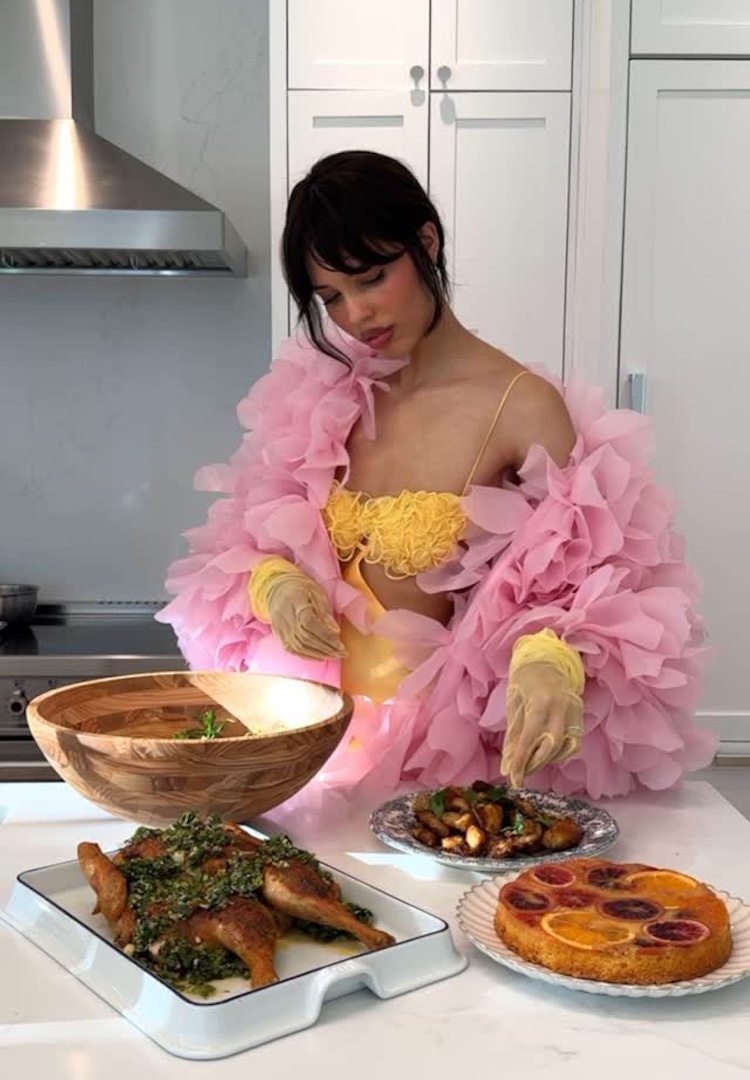
image via @naraaziza/INSTAGRAM
words by Imi Timms
“You want a tradwife but you aren’t a trad man…”
In the murky reeds of an internet forum dedicated to tradwives, a man seeks a woman. “I just want to be with a woman I can love who will love me; someone who will be a woman for me and let me be her man”, he writes.
The man is met with forthright advice. “If she’s not a tradwife material, you can either mold [sic] her into one or go find another.”
For more sex and relationship stories, try our Life section.
“I feel like maybe I’m not comfortable molding a partner…” he gently counters.
Another questions, if not derides him, for his apparent lack of masculinity. “You want a tradwife but you aren’t a trad man… You will have to lead the tradwife. That’s how it works. The man molds the woman into what the family needs.”
I started scouring this side of the internet after downloading a couple of dating apps, trying to get a temperature check on the current landscape. And it turns out the dating world has changed vastly during my four-year hiatus from the apps. Most glaringly, people have become more direct in declaring their desires.
Their wants waiver in intensity – some are after brief encounters, others are looking for something more durable, some seek an additional person to introduce into their relationship dynamic. Each to their own, I’d normally say.
But lately, I’ve noticed men being more forthright in their pursuit for a so-called tradwife. They state that they want a ‘traditional’ woman, or euphemistically couch it as seeking someone ‘feminine’. While I’m not claiming that my Hinge feed is the epicentre of social anthropology, it’s made me wonder if this reversion to ‘traditional’ ideals is symptomatic of sinister undertones.
What exactly is a ‘tradwife’?
The tradwife is exactly as it reads on the tin: a subscription to heteronormative gendering, where a woman’s primary purpose is to cook, clean and bear children for her husband, the provider or breadwinner.
Alena Pettitt, a UK-based lifestyle blogger and founder of The Darling Academy (also referred to as a ‘ministry for housewives’), summarised it succinctly. According to Alena, “it’s about submitting to and spoiling [my] husband like it’s 1959”. Where stay-at-home parents may choose to remain at home for a variety of personal and financial reasons for the sake of the family unit, tradwives denote a lifestyle of subservience to a husband.
Dr Kiriloi M. Ingram and Dr Kristy Campion of Charles Sturt University describe the ideal of a tradwife as “a fantasy twist on history“. The tradwife prototype is representative of a narrow period of history when women were refused entry to the workforce, rather than some kind of utopia.
A cursory search of #tradwife on Instagram draws videos of women pouring flour into cooking bowls, tutorials on embracing ‘feminine’ energy and advice on “becoming the woman he needs”.
Some take more extreme views. “A wife’s body belongs to her husband”, one user wrote on Instagram. “I never say no intimacy because my body is not mine… Don’t let feminism get it twisted”.
Choice is at the core of feminism, and the greatest gift of the movement is the ability to elect the lives we want to build for ourselves. But there is an alarming difference between choosing a lifestyle entirely of your own accord, free from societal expectations and gender roles, and sliding into a life defined and controlled by someone else’s fantasies.
The appeal of the nuclear family
The notion of a nuclear family is a major aspect of conservative politics, Dr. Lauren Rosewarne, Associate Professor at the University of Melbourne, tells me.
“The nuclear family template in conservative ideology is not just about two kids and a golden retriever, but also a woman whose identity is centred around the household: she looks after the domestic space while the man is the primary breadwinner,” she explains. “This is appealing to conservatives because it keeps women in a subordinate role and with restricted choice and very limited power.”
Dr. Campion and Dr. Ingham’s work echoes this sentiment, highlighting the connection between conservatism, racism and the tradwife movement. “Far-right tradwives believe contemporary society is beset by decadence and consumerism, sexual depravity and promiscuity,” they write.
“Becoming a tradwife is one way far-right women push back against these supposed threats… It makes women’s subordination to men seem legitimate, even natural.”
“I want a wife”
I question whether there is a link between incels and men seeking tradwives. “The answer is sort of, but it’s complicated,” Dr Rosewarne responds.
“Many incels believe that women have too much choice and too much power, leading them to choose to not prioritise men. This dynamic invariably means that certain kinds of men find themselves uncoupled. Rather than looking inward and questioning why do women find their politics and personality unattractive… they blame feminism, and they think that answers lie in the imposition of traditional gender roles.”
In my internet trawling, I find some women who view the tradwife lifestyle as a rebellion against feminism… despite the fact that feminism gave them the right to choose.
Writer and feminist, Judy Syfers’ satirical staccato essay, ‘I Want a wife’, sears with the same ferocity as it did in 1971. A wife and mother herself, she wrote: “It suddenly occurred to me that I, too, would like to have a wife… I want a wife to go along when our family takes a vacation so that someone can continue to care for me and my children when I need a rest.”
“I want a wife who will not bother me with rambling complaints about a wife’s duties. But I want a wife who will listen to me when I feel the need to explain a rather difficult point I have come across in my course of studies… I want a wife who will remain sexually faithful to me so that I do not have to clutter up my intellectual life with jealousies.”
Despite the vast pushes in feminism to be able to be ambitious and envision larger lives for ourselves, the reality is we’re still doing more than 50 per cent of the housework. We’re taking time off and facing career setbacks to have children and end up absorbing the majority of caregiving responsibilities.
The tradwife these men seek is ironically still here, she just wears suits and stilettos and somehow juggles even more than what she did 70 years ago.
For more on tradwives and dating, head here.
Liked this? You’ll love these...