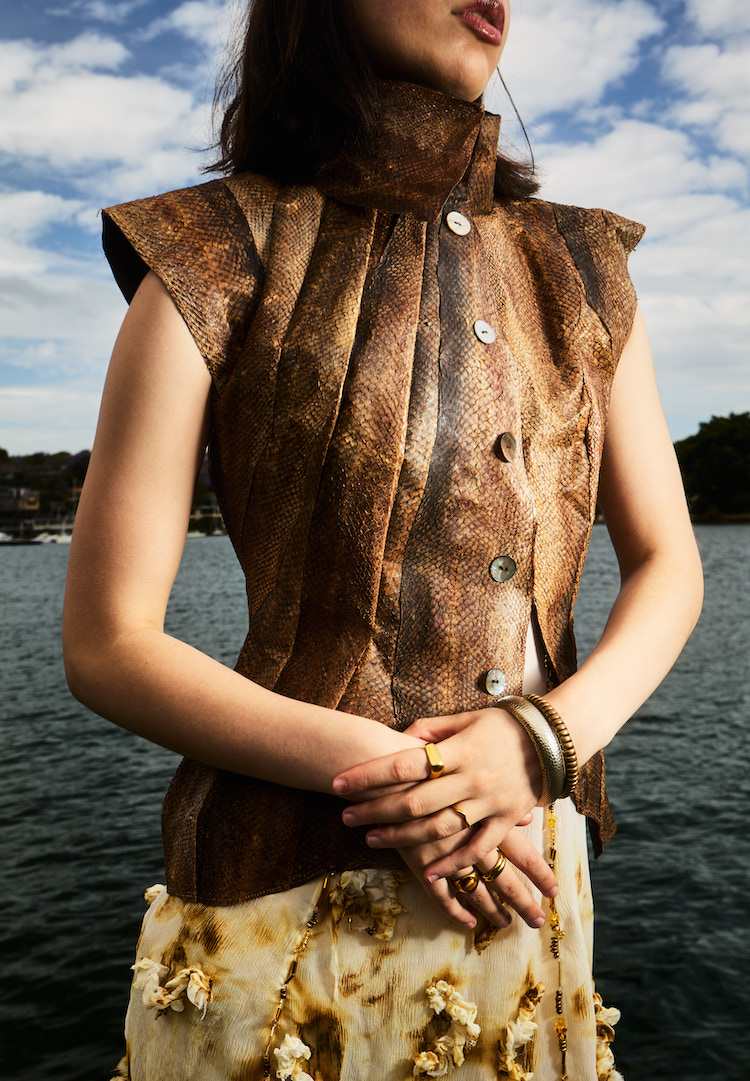


This Sydney-based designer turns salmon skin into avant-garde leather
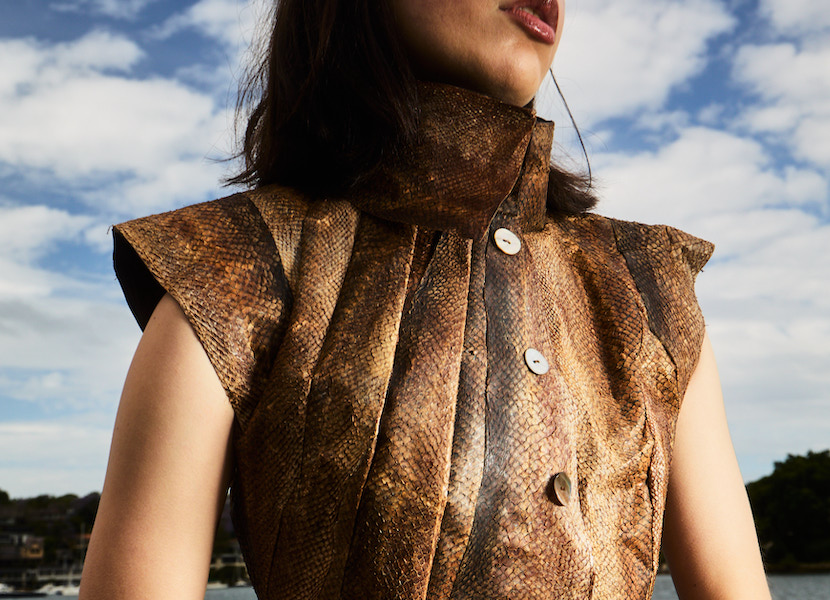
Photography by Lachlan Connor
words by lara daly
Laura Casiglia spent months experimenting to turn discarded salmon skins into wearable leather.
Gen Z cops a lot of flack when it comes to social media-fuelled overconsumption. But TikTok isn’t just a stream of shopping hauls and microtrends. A growing community of young DIYers is using the platform to champion the antithesis of fast fashion.
Search #upcycling on the app and you’ll find over a million videos of creators sharing how they breathe new life into old materials. The range of innovation is remarkable – from corsets made from old T-shirts and kid’s toys transformed into heels, to discarded fish skins turned into leather.
For more on slow fashion, head to our Pre-Loved section.
Sydney-based design student, Laura Casiglia, first came across fish leather after seeing a TikTok from London-based fashion designer, Isabelle Taylor. Intrigued, she began a long and arduous journey of trial and error in an attempt to make her own.
It started with a visit to her local fish markets, where she sourced bags of salmon skin – a byproduct of the meat that’d otherwise be thrown away. The skins are thoroughly cleaned before beginning a 12-day tanning process, during which the skins are bathed in black tea. This is followed by a three-day stretching and drying stage, before a leather conditioner is applied to seal and finish the material.
Laura documents the entire journey on her own TikTok, including the inevitable ‘fish flops’ – when things don’t go to plan. “Of the first 80 skins I produced, half disintegrated during the process and the other half developed mould while drying… There were many sleepless nights,” she tells me.
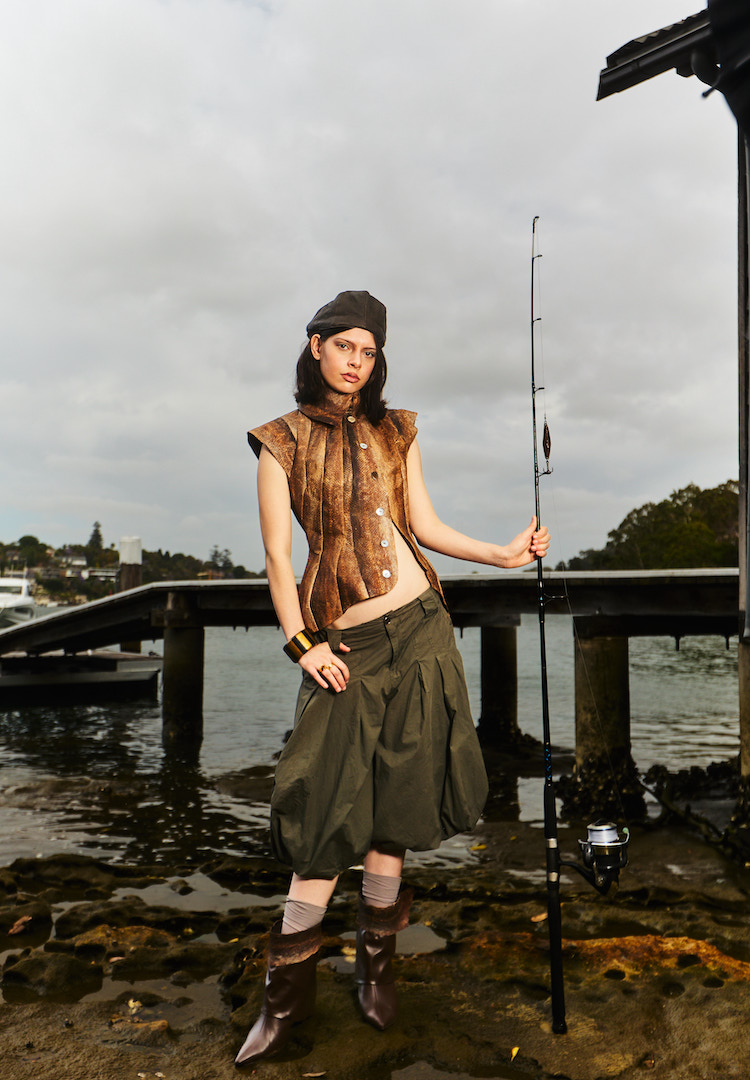
Despite the challenges, discovering unconventional, sustainable materials is exactly what Laura hopes to keep exploring in her work. Her current mission? Transforming discarded fish scales into sequins for embroidery in couture designs. “I’ve come to understand the remarkable potential that exists in so-called waste materials, which, with the right vision, can become compelling, high-fashion pieces,” she says.
Her latest capsule collection, shot in Sydney with a team of local creatives, is proof. Eager to hear more about the process (and ask the all-important question: will it make me smell like sushi?) we spoke to Laura about her inspiration and the future of her label, Mercury.
Fashion Journal: Hi, Laura! Tell us a bit about your background in fashion so far.
Laura Casiglia: My name is Laura, I’m the designer and maker behind Mercury. I am currently completing the final year of my fashion degree at Fashion Design Studio (FDS) in Sydney and I’m set to graduate at the end of 2026.
Have you always wanted to be a designer?
Creativity always came naturally to me and from a young age, I knew I wanted to pursue something in the arts. Under the guidance of an exceptional high school teacher, I fell in love with sewing and discovered fashion as a vehicle for self-expression. That passion was clear enough that I made the decision to leave school early and enrol in a Certificate III and Diploma in Fashion Design at TAFE, which ultimately led me to FDS to pursue my degree.
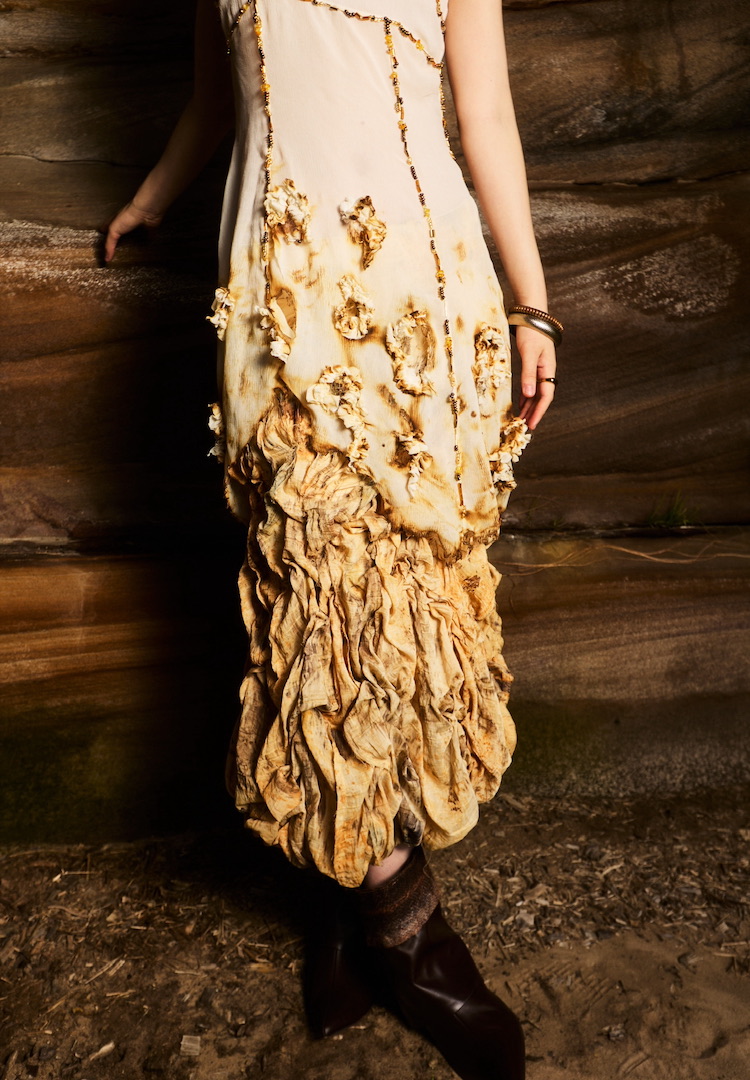
Tell me about your designs using fish leather. What was the process like?
I first came across fish leather through TikTok creator Isabelle, a London-based fashion designer. From there, I dove into research and discovered that the material has deep roots in Indigenous practices across riverine and coastal communities worldwide. [It’s] an ancient craft documented in Japan, China, Siberia, Canada and Alaska, where fish skin was essential to survival and used for boots, bags, coats, thread, and shelter.
There are many approaches to producing fish leather and I worked through significant trial and error to find the right method for my design. The process began with a visit to the fish markets, where I sourced bags of salmon skin, which is a byproduct of the salmon meat they sell, that would otherwise be discarded at the end of the day. I cleaned the skins by removing the meat and scales, then soaked them in a detergent bath to eliminate grease and bacteria.
I used the black tea tanning method: a 12-day bath in black tea, with the water changed daily. The tannins penetrate the skin fibres, gradually transforming them into leather. Once the tanning was complete, I removed all 40 skins and worked each one over an edge to stretch and soften them before stapling them to wooden boards to dry for three days. After drying, I stretched them again and applied a leather conditioner to seal and finish the material.
A question I’m often asked is, does it smell like fish? By the time the leather is fully tanned and processed, I’d describe it as a subtle hint of sushi mixed with a natural bark and black tea smell, yum! I document the full process in a series on TikTok.
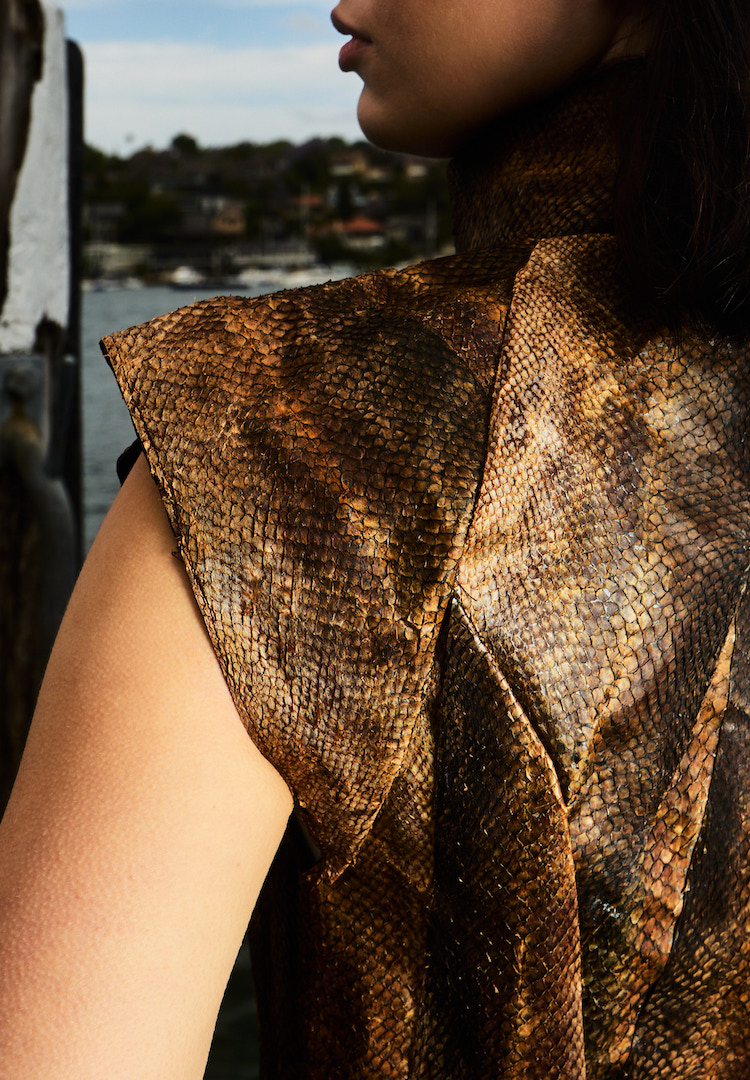
What does sustainability in the fashion space mean to you?
Sustainability is the starting point for everything I create; it shapes my design direction rather than being an afterthought. I’ve come to understand the remarkable potential that exists in so-called waste materials, which, with the right vision, can become compelling, high-fashion pieces.
For this look, I worked exclusively with deadstock natural fibre fabrics across every element, from the fish leather to the main fabrics and all the linings. The skirt was dyed using native flowers, cabbage and rust dye from discarded metal objects. I find that these alternative techniques often produce the most organically beautiful and unexpected results in texture, colour and concept.
What are you most proud of in your work so far?
I’m most proud of this full look, which is my second-year major work at FDS. The road to completion was riddled with complications and errors. Of the first 80 skins I produced, half disintegrated during the process, and the other half developed mould while drying, meaning that I had to produce another 40 skins, as the deadline was rapidly approaching.
There were many sleepless nights. But pushing through those setbacks to finish the piece is something I’m proud of. Beyond the technical challenges, I was able to find a deep emotional connection to the brief, which centred on personal memory and ancestry. The work honours my family’s Italian heritage and some of my earliest childhood memories. My Nonno on my Mum’s side grew up in a small fishing village off the coast of Sicily and, after moving to Australia, built a career as a fisherman.
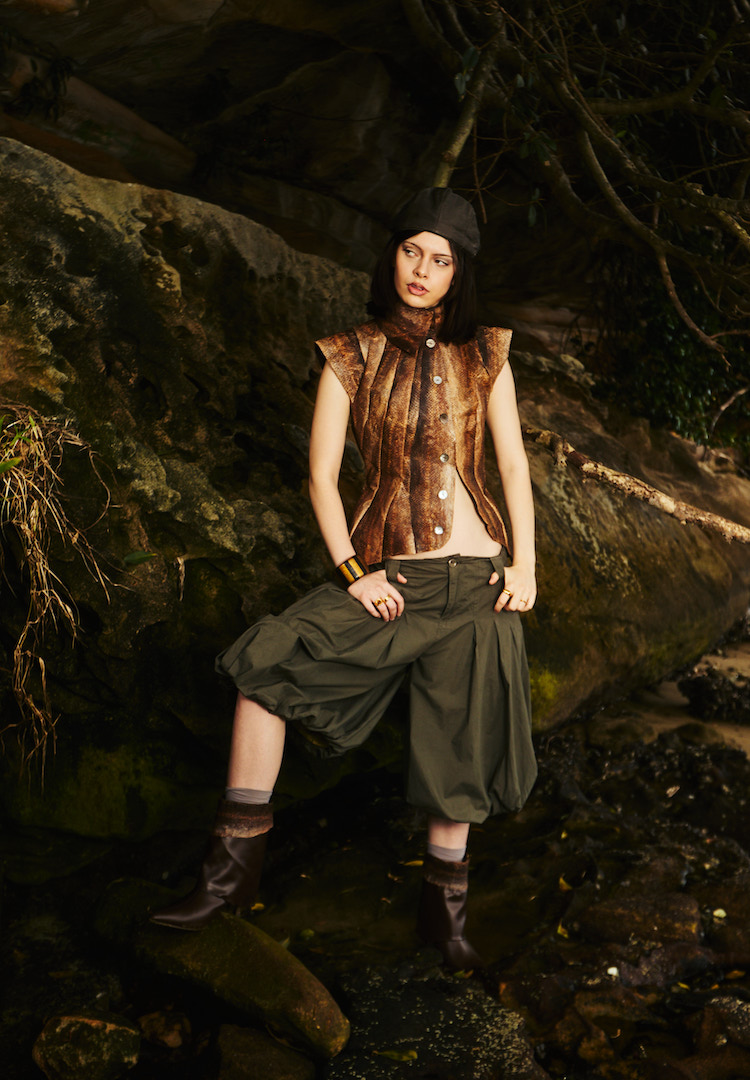
As a child, he would take my siblings and me out on the water and teach us how to fish. Some of my earliest and only memories that I have with my late Nonno on my Dad’s side were sitting beside his koi pond together and feeding the fish. I look back at those memories fondly and am grateful to have had them. Being able to carry those moments into my work made every difficulty worth it.
What are you hoping to communicate through your designs?
I aim to create pieces that speak for themselves; garments that don’t require explanation but invite interpretation. I craft handmade, sustainable pieces using innovative textiles, with the belief that a genuine connection to the design process translates into clothing that resonates. What that meaning looks like is ultimately up to the wearer.
Are there any other unique materials you want to explore in your work?
I find real joy in creating unexpected textures through sustainable, organic processes. For my graduate collection this year, I’m planning to explore bioplastics, which are materials derived from renewable biomass sources such as corn starch, sugarcane, or cellulose, designed to be biodegradable, unlike conventional petroleum-based plastics. I’m also interested in upcycling waste materials such as plastic bottles and aluminium cans, and finding ways to integrate them meaningfully into my designs.
In parallel, I’m continuing to develop and refine different fish leather techniques to achieve varied textural outcomes. I’m also exploring the possibility of transforming discarded fish scales into sequins for embroidery in my couture work.
Who did you collaborate with on your photoshoot for Mercury?
I worked with a wonderful team; photographer Lachlan Connor, model Corina Brillembourg and stylist Julia Baston.
Who is exciting you the most in local fashion right now?
I’m very excited for the upcoming generation of fashion designers. The recent graduates from FDS who are leading with sustainability and pushing creative boundaries are a constant source of inspiration. Just to name a few: Oliver Parry, Shiva, Tate Boswarva and Luke Ruben.
I’m also inspired by my close friend Jack Job, whose avant-garde approach constantly challenges me to reimagine what’s possible in design, and to always fall in love with the developing process. I recently showed at the Raw Form runway alongside many local designers, and that experience reminded me how vibrant and diverse the creative community in Sydney is.
What do you have planned for your label this year?
This is shaping up to be a significant year for Mercury. As my final year of study, I’m deep in the development of my couture collection, where I’m exploring themes of femininity, water and movement through storytelling. I’m pushing myself both in terms of concept and craft, revisiting techniques I know, while introducing new materials and textures. Mercury’s debut runway is scheduled for late November 2026.
What are your goals with Mercury in the next five years?
My long-term ambition is to establish Mercury as a made-to-order demi couture label, which has been a goal at the centre of my vision for some time. With the foundation my education has given me, alongside the encouragement of those around me, that vision feels gradually more achievable. I believe deeply in craftsmanship, considered design and in the value of handcrafted, one-of-a-kind pieces for a market that’s hungry for something different.
Keep up with Laura’s projects here.
Liked this? You’ll love these...