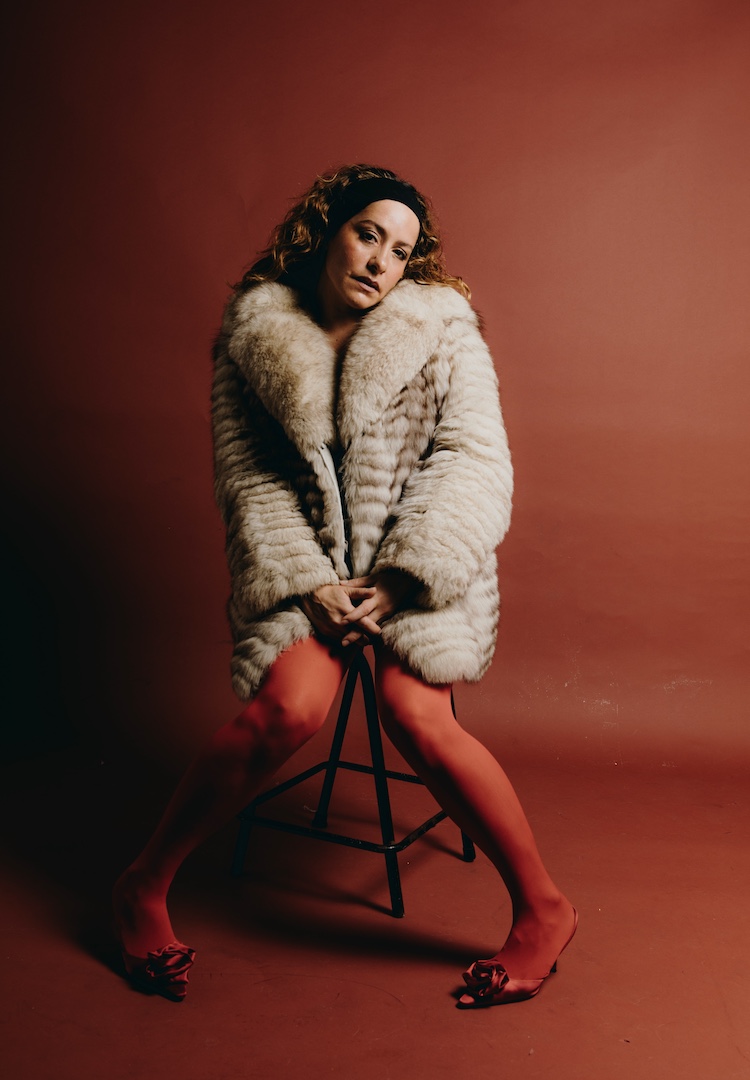


How I Got Here: Kate Ten Buuren on collaboration, Country and curating First Peoples Melbourne Art Trams
photography by Laura du Ve
as told to daisy henry
“First Peoples art and storytelling is a central, pivotal part of contemporary art in so-called Australia.”
Welcome to How I Got Here, where we talk to people who are killing it in their respective fields about how they landed their awe-inspiring jobs, exploring the peaks and pits, the failures and the wins, and most importantly, the knowledge, advice and practical tips they’ve gleaned on the journey. For this instalment, we speak with Kate ten Buuren, a Taungurung woman, artist and curator working across film, public art and exhibitions.
This year, Kate is also the curator of Rising’s First Peoples Melbourne Art Trams – a role she didn’t know existed growing up. Kate always knew she was creative, whether it involved writing stories, making art, or developing photos in the darkroom at her high school. “I really believe even my most left-of-field experiences have led me to where I am,” she says.
Looking for a new nine-to-five? Head to our Careers page for new listings daily.
With dreams of becoming a photojournalist, Kate went on to study a Bachelor of Arts and a Bachelor of Visual Arts, and formed this mob, an arts collective for emerging Aboriginal and Torres Strait Islander artists. “We’d put on pop-up exhibitions, throw parties, host art-making workshops and impromptu poetry nights,” she reflects. From there, she landed a job as Assistant Curator, progressing on to various curatorial roles with ACMI and Melbourne Arts Precinct, before landing at Rising.
Led by Kate, Rising’s 2026 First Peoples Melbourne Art Trams will feature six new tram designs from six First Nations artists. “It’s been nourishing to work on a project that is so loved by all and particularly valued by the Aboriginal community for its commitment to sharing our stories across the city,” she says. “They’re a constant reminder to all that this always was and always will be, Aboriginal Land.”
Though Kate has had plenty of experience across the field, she’s hesitant to describe it as “climbing the ladder”. “For me, it’s not always about an upward trajectory but ensuring the work I’m doing means something,” she says. “I see it more like a ripple effect.”
View this post on Instagram
Fashion Journal: Hi Kate! Did you have an idea of your ‘dream job’ growing up?
Kate: I had so many phases. I wanted to be an outdoor education teacher so I could be in nature all day. I remember doing a quiz with the careers counsellor at school, and trawling through a giant directory of jobs and what you had to score in your exams to get into a degree. In hindsight, that’s all such a hoax because there’s not one clear way into anything and I really believe even my most left-of-field experiences have led me to where I am.
I didn’t know all of the different kinds of jobs you could have within the creative industries, so the job of a curator was never on my radar. But I was always creative – writing stories, making art, filming and performing. My high school had a darkroom, so in my senior years, I’d arrive at school early and develop film from photos I’d taken on a camera my mum passed down to me. I wanted to be a photographer and settled on the idea of being a photojournalist.
I also had a part-time job at the local picture framers. Most of the time, I would be out back in the workshop, constructing frames alongside my brother. But we also had to work with customers, helping them to decide what would suit the artwork and their homes.
I think back on my late teens and being interested in education, telling stories, working with images and making design choices. Looking back, I think it all makes sense. I see all of these experiences adding to the pathway that has got me to where I am.
View this post on Instagram
Take us back to when you were first starting out. Did you study formally, or did you start with an entry-level role and climb the ladder?
I studied a Bachelor of Arts and a Bachelor of Visual Arts. I worked a bunch of different jobs around that time – the framing shop, cafes, call centres, pool cafeterias and car washes. I was also making art and formed an arts collective for emerging Aboriginal and Torres Strait Islander artists called this mob.
At that time, there was a real DIY, collective energy humming, and we collaborated a lot with other collectives to put on the events and exhibitions, with the vision of bringing the community closer together. We’d put on pop-up exhibitions, throw parties, host art-making workshops and impromptu poetry nights.
After curating a few shows, I got an Assistant Curator job at the Koorie Heritage Trust, where I worked on exhibitions, oral histories, and the collection of Southeastern cultural belongings and artworks. I completed the Wesfarmers Indigenous Leadership program at the National Gallery of Australia, where I met mob from all over the continent, and then went into curatorial roles at ACMI and the Melbourne Arts Precinct. Last year, I curated the Telstra National Aboriginal and Torres Strait Islander Art Awards at MAGNT in Darwin, and now I’m at Rising working on the Art Trams, while also maintaining my independent curatorial practice.
I’ve been very supported and held by my community to pursue this work. I’ve had great mentors and opportunities for growth and I feel very grateful for all the people who’ve held doors open for me and forged the spaces that I now work in. Places like Footscray Community Arts and Blak Dot Gallery, where they champion Indigenous work, were really pivotal in my growth.
I don’t love the concept of climbing the ladder and how it implies that the only right way is up or that it’s going to be a straight path to get there. For me, it’s not always about an upward trajectory but ensuring the work I’m doing means something, is worthwhile and doesn’t completely destroy me in the process. I see it more like a ripple effect, with many people and experiences that have got me to where I am.
View this post on Instagram
How did you find yourself working for Rising?
In 2024, I was the Senior Curator at Melbourne Arts Precinct and collaborated with a good friend and curator, Kimberley Moulton, who is a Yorta Yorta woman and Senior Curator at Rising. We co-curated The Blak Infinite, a large-scale public art project that saw Fed Square become a constellation of First Peoples’ art and stories.
In late 2025, Kimberley extended the invitation to me to curate the Art Trams. I was really honoured because the Art Trams are such a quintessential part of Melbourne and one of the biggest public art projects on the continent. Since 2021, the trams have been a dedicated space for sharing First Peoples art histories and contemporary practice, shining a light on artists with connections to Victoria.
Can you walk us through what a typical day in your life on the job is like as a curator of the First Peoples Melbourne Art Trams?
Kate: Over the last few weeks, I’ve been visiting the Art Trams artists in their homes and studios to record video interviews with them, talking about their artworks and reflecting on the process of making a tram. Art Trams is a fast-paced project, which quickly moves from writing the curatorial brief into collaborative design sessions with artists and our designer, Kate Francis.
There’s a whole process of learning about what goes into making an Art Tram, the technical requirements and safety considerations, while ensuring the integrity of each artwork and that the artists’ vision is coming to life. I’ve been developing a series of public programs called Blak Art on the Move, which includes relief printmaking workshops, hop-on hop-off tram tours and artist talks.
There is, of course, lots of desk time doing emails and schedules, and general project management. But this week I was able to escape the office and went behind the scenes to see the artworks being printed. I usually break up office time by seeing exhibitions, visiting artists in their studios and going to talks and openings. When Rising begins, we’ll be launching the Trams one by one over a fortnight, hosting the talks, workshops and tours and seeing some of the shows within the festival.
View this post on Instagram
What has this experience working on Art Trams been like?
It’s been nourishing to work on a project that is so loved by all and particularly valued by the Aboriginal community for its commitment to sharing our stories across the city. The Art Trams have a huge audience, from local commuters to visitors from overseas and they literally carry the stories of First Peoples with them across the city and suburbs.
I’ve got to work with six incredible artists – Aunty Marlene Gilson, Sonja Hodge, Jenna Mayilema Lee, Zena Zada Cumpston, Mitch Mahoney and Natasha Carter who have either created new artworks or adapted existing works for the Trams. Their works all reflect on time, memory and the limitless possibilities of First Peoples’ imagining.
I’ve learnt a lot of new things I never thought I’d know about trams – their classes and routes, and the technicalities of wrapping art over a 50-plus-tonne moving metal canvas. Just about everyone I talk to has a memory to share of an Art Tram – often about them arriving at very poignant times in their lives when they’ve needed a little pick-me-up. They’re a constant reminder to all that this always was and always will be, Aboriginal Land.
What is a common misconception about your industry or your role?
Probably that being a curator is all expensive champagne and schmoozing at art openings (which is partly true). I recently interviewed for a project where the hirer said the job was to “make sure nothing was hung upside down”. I think people underestimate the level of care, knowledge, rigour and creativity necessary to do it.
View this post on Instagram
What do you want people to know about your industry and role?
First Peoples art and storytelling is a central, pivotal part of contemporary art in so-called Australia. I’m particularly passionate about amplifying the work of artists from the Southeast of this continent, who are making incredibly diverse, culturally rich, exciting and innovative work.
There are a lot of assumptions about what Aboriginal art is and there’s a lot of institutional racism that dictates how the systems are working and how we, as Aboriginal people, fit within them. I hope that people see the value that First Peoples bring, and that when we create structures that best suit us and that honour our 80,000 years of culture and survival, we are creating spaces more inclusive to all.
We need more mob working in the arts and more support, investment and willingness to change from institutions to allow for First Peoples-led programs and ways of working.
What’s the best part about your job?
Working with artists and the community. All I can say is thank god for all the artists and storytellers in this world, speaking their truths and expressing their creativity in whatever means necessary. It’s hard to be creative in a world that devalues voices outside of the mainstream or those with different opinions and experiences. It’s a gift to be able to spend my time learning about people’s worlds and the things that matter to them, and supporting sharing those stories.
What would surprise people about your role?
The job of a curator sounds very glamorous, but there’s a lot of basic admin and pragmatic tasks like budgeting and applying for grants. It’s not all creative.
View this post on Instagram
What skills have served you well in the industry?
Listening is one of the most important skills that serves me as a curator. I’ve always loved being told stories and listening to people reflecting on their lives is such a gift! Studying journalism, I learnt interview techniques, which really is just listening to what the person is saying and responding with curiosity, adapting as necessary to what they say.
I learnt how to craft a story and how to interpret knowledge that I was being told or shown. For me, that has shaped how I work as a curator, understanding the story and the person behind the artwork, being able to read the work and then collaboratively sharing those stories for a broad audience.
What has been a major career highlight for you?
Most recently, I would have to say being at the awards ceremony for the Telstra National Aboriginal and Torres Strait Islander Art Awards up in Darwin. It was so special to have curated the exhibition in 2025 and having an evening to celebrate the winning artists from across the continent, with the background of a beautiful sunset over the Larrakia ocean, was stunning. Moments to come together to celebrate are few and far between. I really treasure that memory, and getting to have my friends and family there.
What advice would you give to someone who wants to be in a role like yours one day?
I would say to other Aboriginal and Torres Strait Islander people who want to be curators, that who you are and where you come from is a gift. Do things that make your spirit full. Surround yourself with good people, seek advice and take your community with you wherever you go.
Try new things, and be true to your own unique style and approach, even though it may take others time to catch up. Know your own worth and make sure you have balance!
What about a practical tip?
Listen and don’t hang anything upside down.
Keep up with Kate here.
Liked this? You’ll love these...