


Growing pains: The unique grief of starting a new life abroad

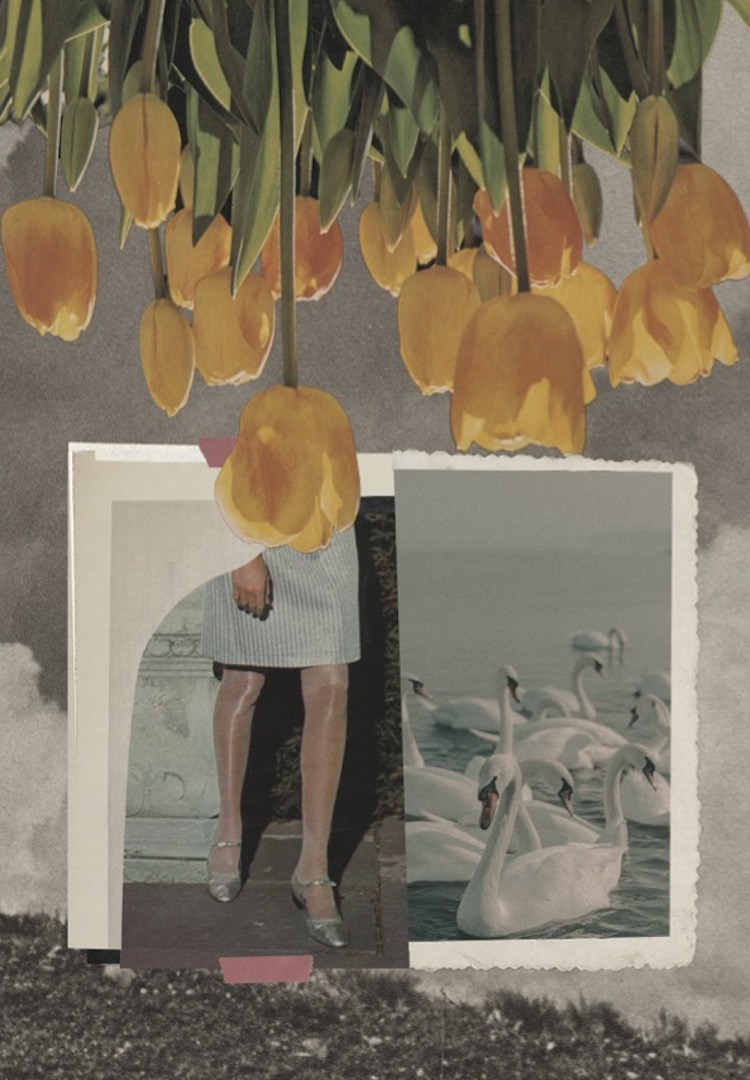
collage by Simone Esterhuizen
Words by Maryel Sousa
“The refuge we find in memory must eventually give way to the pain of grief, or we’ll never reach acceptance.”
I’m sitting on the dirty floor of my Brunswick sharehouse kitchen, unperturbed by the collection of crumbs beneath the cabinets or the mousetrap in the corner. No one’s here to hear me – no one’s ever here – so I cry. I’ve been in Melbourne for five months, and I want to go home.
In my head, I’m eight years old again. My mum and I weave through throngs of early morning Black Friday shoppers who plod through the mall like cattle. Mum asks if I’d like to go to the diner downtown for breakfast. I would. My stomach is still heavy from last night’s Thanksgiving dinner, but I think I’ll have room for chocolate chip pancakes when we get there. She turns on holiday music and begins to drive.
Interested to hear how others navigate the world? Head to our Life section.
My breath fogs up the backseat window and I draw Christmas trees with my finger in the thick condensation. Through the lines, I watch the landscape rush by, imagining myself a white-tailed deer running through the endless fields.
According to the Australian Bureau of Statistics, 568,000 migrants arrived in Australia last financial year – down 14 per cent from the year before. This past Invasion Day, large rallies descended on Melbourne’s CBD to oppose immigration. Online, users engage in daily debates over the same question: What came first, the immigrants or the housing crisis?
The public discourse is, understandably, centred on what incoming migrants mean for Australia. To both defenders and opponents, each immigrant is another data point to reference, evidence for what we, as a hegemony, bring and what we take away. But by focusing on the broader implications of our arrival, the conversation often overlooks what’s been left behind.
The decision to leave home – whether due to war, love, opportunity, or adventure – is personal, and no matter the reason, comes at great personal cost. Something must always be sacrificed.
Yet because immigrants’ presence is so hotly contested, to feel anything but gratitude invites the reminder that the door swings both ways. If we’re unhappy, we’re told we can leave, and if we leave, our sacrifice would have been for nothing. So, with no room for outward grief and no path home, we turn to our memories – a past no one else can touch.
My homesickness has steadily compounded over the past several months. Every moment seems to beat on, drawing me further into the past, to a world that no longer exists.
Back home, fields still roll past the horizon but they’re more accent than feature, framed by brand-new, identical apartment complexes. The mall has become a relic of the past, an easy drop-off point for online shopping returns, and our sleepy downtown has since gained a beer-garden- slash-taco-joint favoured by millennial commuters. Political division has seeped into every aspect of daily life, including the family dinner table.
Home, as it turns out, doesn’t stay frozen in time. People marry, are born, die. Shops close down, buildings spring up. Home moves forward, even if I’m not there to see it.
Xinyu*, who recently migrated to Melbourne, says memories of home are bittersweet. “Whenever I stand in the backyard at night and look up at the stars, I can’t help thinking of my home and loved ones in China.”
According to a Sydney-based psychologist Let’s Reconnect podcast host, Breanna Jayne Sada, nostalgia can restore a sense of meaning when people feel untethered. “In many ways, remembering home or the past is the mind’s attempt to reassure us that we belong somewhere and are connected to something,” she explains.
“You have to be in it to fully understand it,” Xinyu shares. “We have to give up so many things, the ones we love, the type of life we’ve lived, then we come to a totally new world like newborns, and we have to restart everything.”
For many immigrants, empathy from home can be equally hard to come by. Photographer Richmond Kobla Dido feels a sense of survivor’s guilt for having left his home country, Ghana, in 2007.
One in three Ghanaian youth are at risk of experiencing depression, economic instability hampers the country’s progress, and Richmond believes the weight of these struggles makes it difficult for those at home to understand his migratory grief. “People back home may view you as having made it out, when in reality, you also face new challenges in a foreign land,” he says.
Breanna finds that many immigrants struggle to make peace with what they’ve left behind. Places continue evolving while we’re away and whether we’re aware of it or not, we change, too. We can’t fossilise our home nor our place in it, and in clinging to a time that will always escape our grasp, we risk losing the home we’re trying to build.
Despite having arrived in Australia less than a year ago, Xinyu’s home has already begun to move on without him. His parents are growing older, his beloved dog NiuNiu recently passed away, and late-night phone calls from China ignite fears of unexpected change. The inevitability fills him with regret.
“When someone is deeply attached to the past, new relationships can unconsciously feel like replacements rather than additions to their life,” Breanna says. “They might withdraw socially, idealise the past, or unintentionally reject aspects of the new culture because it feels disloyal to where they came from. Over time, this can prolong feelings of isolation and make the transition feel incomplete.”
She tells me that part of adaptation is allowing the new place to become emotionally meaningful in its own right, even when it’s uncomfortable. But how do we reconcile the life stored in memory with our ever-changing present?
I’ve begun thinking of my life in two parts: before I left home, and after. I spend so much time looking at my memories that they’re starting to fade, like photographs left out too long in the sunlight.
The possum who runs along my fence at dusk now carries three babies on her back. Weeds are strangling the garden, and they tickle my legs when I pass through the front gate. The world is defrosting without me.
I lie in bed and think about last spring, when I visited Keukenhof and strolled through the tulip fields, treading each of the garden’s serpentine paths. I was at a crossroads, but unlike at Keukenhof, I could walk only one pathway: the familiar or the unknown.
I chose the unknown. Now I’m angry at Melbourne, angry at myself for having moved here, angry at time for marching onward instead of letting me be eight years old forever.
But there is no road back, only forward.
Even after nine years in Australia, Richmond still longs for Ghana and his family. For him, the concept of home has become complicated.
Home represents far more than geography: safety, culture, family, routines, our very identity. When it changes or is left behind, we may feel as though we’ve lost access to an important part of ourselves. “Grief is not only about death,” Breanna says. “Psychologically, grief can emerge whenever there is loss.”
The cycle of grief is messy; we rarely move across its milestones in straight lines, and it can often feel as though we haven’t moved at all. Nostalgia can ease our passage through, but the temptation to soak in it can also bring our journey to a standstill. The refuge we find in memory must eventually give way to the pain of grief, or we’ll never reach acceptance.
Two truths coexist: the home we remember meant something, and the current version can, too. One doesn’t cancel out the other.
I asked Richmond and Xinyu if Australia feels like home. Not yet.
But despite the discomfort, both are carving out their place here. The people around them have been both anchors to home and safety rings in a foreign sea. Family phone calls, dinners with friends, even strangers passing by with a smile help the unfamiliar feel a little more bearable. “I guess, in short, we find our sense of home in each other,” Richmond says.
Melbourne is warm today, and my growing pains are starting to subside. I’m sitting across from my boyfriend at Ballard’s in Thornbury, watching him laugh by the glow of a lamp shaped like the moon. I think I love him.
Time will go on, as it always has. My boyfriend and I will return here for anniversaries and double dates and birthdays, and we’ll be happy. But for tonight, to feel at peace for just a little while is enough.
I think, maybe, I’m home.
*Name has been changed.
This article was originally published in Fashion Journal Issue 200.
For more stories of migration, try this.
Liked this? You’ll love these...